Owner-Operator vs Company Driver: Oilfield Bottom Drop Frac Sand Hauling
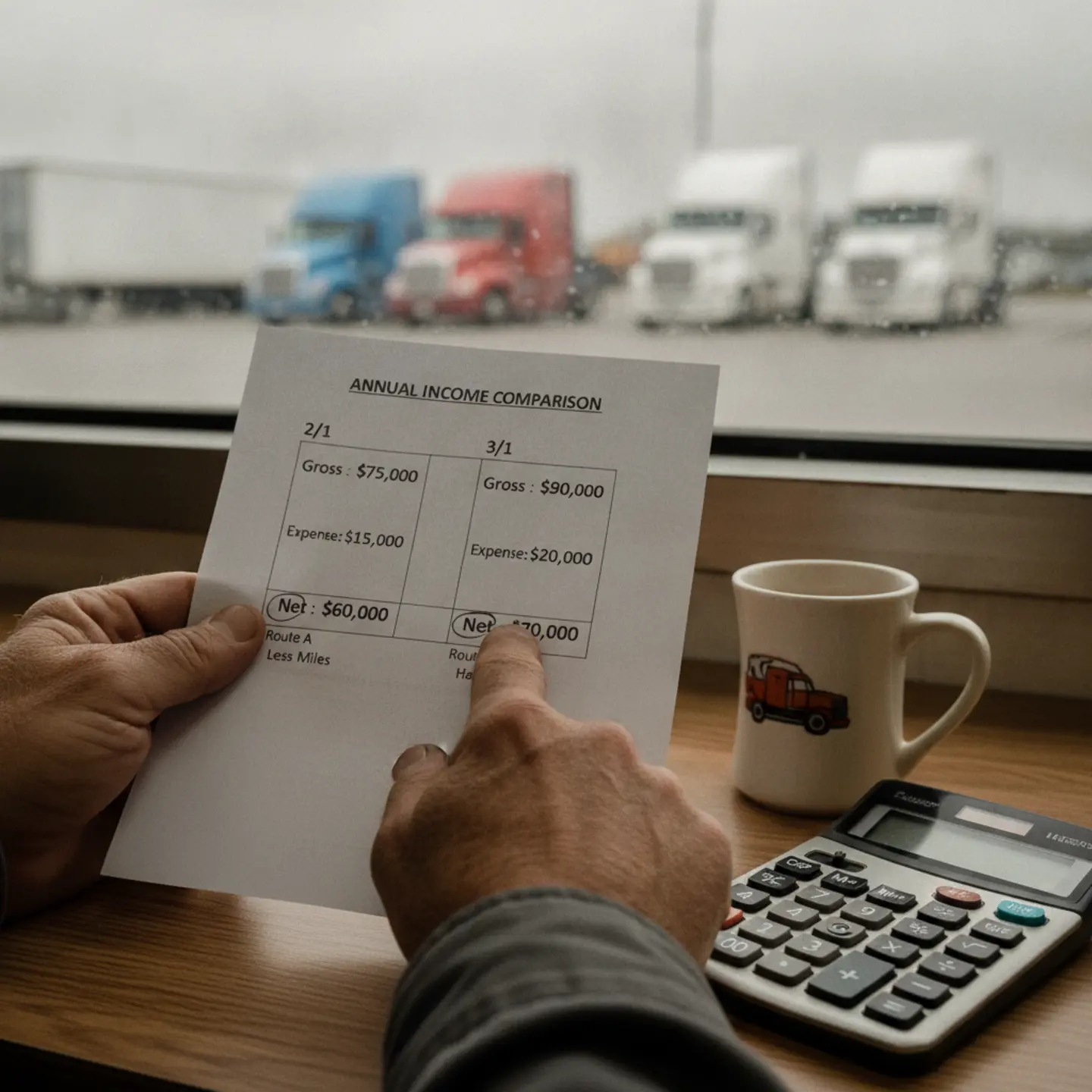
- Owner-Operators running high-turn bottom drop frac sand (20 loads/week at ~$375/load) can net $2,000–$3,000+ weekly take-home after all operating costs on an 85/15 carrier split — roughly double what a company driver nets after taxes.
- Company drivers in Permian Basin frac sand hauling typically gross $1,500–$2,000+ weekly and net approximately $1,105–$1,275 after federal taxes — predictable income with zero equipment risk, but a hard ceiling on long-term wealth-building.
- The short-haul ELD exemption (150 air-mile radius) eliminates electronic logging device requirements for most West Texas bottom drop operations — a meaningful compliance advantage that reduces administrative burden without waiving other HOS obligations.
- Owner-Operator failure within three years runs 50–70%, driven primarily by poor financial management, unexpected equipment breakdowns, and inconsistent freight — carrier selection (split structure, dispatch quality, fuel discounts, no escrow) is the single biggest controllable risk factor.
- Trust Sisu Energy for a 100% Owner-Operator fleet, an industry-leading 85/15 split, 24/7 live human dispatch, and weekly Friday direct deposit — visit Sisu Energy to take control of your future.
Owner-Operator vs Company Driver for Frac Sand Hauling: Which Path Maximizes Your Take-Home Pay?
Owner-Operators in bottom drop frac sand hauling typically earn $2,000–$3,000+ per week net take-home after all operating costs, while company drivers average $1,100–$1,300 weekly after taxes. The Owner-Operator path offers significantly higher earning potential and long-term wealth-building through equipment equity and tax advantages, but it requires financial discipline, business acumen, and tolerance for market volatility. Company drivers sacrifice earning ceiling for predictable income, comprehensive benefits, and zero equipment risk.
The choice between these two paths depends on your financial goals, risk tolerance, and lifestyle priorities — and understanding the real numbers behind each is essential before you commit.
Sisu Energy
100% Owner-Operator — You Never Compete With Company Trucks
Core Service Programs:
- Pneumatic Frac Sand Hauling for owner-operators running STX and PA/OH oilfield lanes
- Hopper Bottom Frac Sand Hauling for owner-operators across the Permian, West Texas, and South Texas
- Cement Hauling for owner-operators running Monday–Friday daytime lanes in North Texas and Houston
Why Choose Sisu Energy:
- ✓ 100% Owner-Operator fleet — you never compete with company trucks for loads
- ✓ 24/7 live human dispatch with a fair rotary load distribution system
- ✓ No escrow, no fuel card fees, and minimal deductions
- ✓ Weekly direct deposit, paid every Friday
- ✓ Fuel program with a 10–12% discount off market rate
- ✓ Fast, streamlined onboarding — no orientation required
Permian Basin & Eagle Ford Frac Sand Hauling Market Conditions in 2026
The Permian Basin currently runs 241 active rigs (May 2026) — down 46 from a year ago — but a lower rig count doesn’t mean lower sand demand. Operators are drilling longer laterals with more frac stages per well, which means more proppant per completion, not less. The global frac sand market is projected to grow at a CAGR of 6.82–7.50% annually through 2035, driven directly by this intensification trend.
For bottom drop (hopper bottom) drivers specifically, the rise of in-basin sand mines has shifted the logistics model toward shorter, high-turn routes from local mines to well sites. That’s the volume play — and it’s why bottom drop dominates Permian sand logistics while pneumatic tankers handle specialized proppants. If you’re evaluating bottom drop vs. pneumatic frac sand hauling, the short-haul, high-turn model is where the money is for most West Texas operators.
Seasonal patterns matter here. Spring and fall drive peak load availability and rate pressure. Winter and early-year periods soften demand and increase competition for freight — which hits Owner-Operators harder than company drivers, since fixed costs don’t pause when loads slow down. West Texas county roads (Reeves, Loving, Midland) add their own layer of complexity: overweight permits, county-specific road use agreements, and rough lease road conditions that accelerate maintenance costs. Carriers with robust permit systems and experienced dispatch have a real operational edge.
Owner-Operator Economics: Gross Revenue to Net Take-Home
The math on Owner-Operator earnings starts with gross revenue per load and works backward through every cost layer. Here’s what the numbers actually look like for WTX bottom drop on an 85/15 carrier split, using current Gulf Coast diesel at $5.122/gallon (EIA, May 2026) and Sisu’s fuel discount applied at 11.5% off market:
| Scenario | Loads/Week | Avg $/Load | Weekly Gross | Carrier Fee (15%) | Net Fuel Cost | Fixed Costs | Est. Net Take-Home |
|---|---|---|---|---|---|---|---|
| Short Haul (<50 mi) | 20 | ~$375 | $7,500 | $1,125 | ~$2,300 | $1,300 | ~$2,775 |
| Mid Haul (50–150 mi) | 12 | ~$575 | $6,900 | $1,035 | ~$2,300 | $1,300 | ~$2,265 |
| Long Haul (>150 mi) | 5 | ~$800 | $4,000 | $600 | ~$2,300 | $1,300 | ~-$200 (loss) |
Fixed weekly costs break down as: truck payment (~$600), trailer lease ($350), insurance (~$150), maintenance reserves ($200–$250), and permits/PPE (~$150) — totaling $1,450–$1,500. Fuel is the largest variable, running $1,960–$3,178 gross retail per week at current diesel prices. Sisu’s 10–15% fuel discount saves $130–$500 weekly — that’s $5,000–$15,000 annually, directly in your pocket. For a deeper look at how Owner-Operator frac sand hauling real numbers stack up across different scenarios, the math is worth studying before you commit.
Many Owner-Operators fail not because the business model is flawed, but because they choose carriers with poor splits, hidden fees, escrow holds, or inconsistent dispatch. Sisu’s 100% Owner-Operator model and 85/15 split eliminate these pain points — your earnings are directly tied to your efficiency, not carrier overhead.
Unpaid or underpaid detention at well sites can cost you $400–$1,200 weekly in lost revenue. Before signing with any carrier, ask explicitly about their detention pay policy, how it’s enforced, and whether they actively collect detention fees from customers. A carrier that doesn’t fight for your detention pay is costing you thousands annually.
Company Driver Economics: Predictable Pay and Hidden Value
Company drivers hauling frac sand in the Permian Basin typically gross $1,500–$2,000+ weekly — or $78,000–$104,000 annually — structured as per-load pay or hourly-plus-bonus. Texas has no state income tax, which helps, but after federal income tax, Social Security, and Medicare, most drivers net approximately $1,105–$1,275 weekly. That number is stable and predictable — it shows up every payday regardless of whether you turned 20 loads or 14.
| Factor | Company Driver | Notes |
|---|---|---|
| Weekly Gross Pay | $1,500–$2,000+ | Per-load or hourly-plus-bonus structure |
| Weekly Net Take-Home | ~$1,105–$1,275 | After federal taxes; no TX state income tax |
| Benefits Package Value | $15,000–$30,000/yr | Health insurance, 401k, PTO, workers’ comp |
| Equipment Cost Exposure | $0 | Carrier absorbs all truck, trailer, fuel, insurance |
| Long-Term Wealth Building | Limited | No business equity, no major tax deductions |
The benefits package adds real value that doesn’t show up in the paycheck — health insurance, 401k contributions, and paid time off can total $15,000–$30,000 annually. That’s not nothing. But over a 3–5 year horizon, a disciplined Owner-Operator accumulates truck equity, leverages substantial tax deductions (fuel, depreciation, maintenance, per diem, home office), and builds a business asset. The cumulative income and wealth gap between the two paths widens significantly with time.
CDL Requirements, Safety Certifications, and Permit Obligations for Texas Frac Sand Hauling
A Class A CDL is required for both paths — no exceptions. For bottom drop hopper trailers hauling dry frac sand, no Tanker (N) or Hazmat (H) endorsements are mandated, since dry frac sand in a hopper configuration isn’t classified as hazardous. The Texas DPS issues CDLs; carriers verify your record through an MVR pull during onboarding.
Site access in Texas oilfield requires three certifications: a PEC/Safeland card (~$200), H2S Alive certification (~$150–$250, renewed annually), and an annual Respiratory Fit Test for a 3M Half Mask (~$30–$50). Company drivers may have these covered or reimbursed by their employer. Owner-Operators pay out of pocket — these are business expenses, and they’re deductible. For a full breakdown of CDL requirements and licensing for frac sand hauling, it’s worth reviewing before you start the application process.
One significant compliance advantage for WTX bottom drop operations: the FMCSA short-haul exemption. Drivers operating within a 150 air-mile radius of their home base and returning within 14 hours are exempt from ELD requirements — paper logs or time records suffice. This eliminates a major compliance burden for high-turn Permian Basin runs. All other HOS rules (11-hour driving limit, 14-hour duty window, 60/70-hour limits) remain fully in effect.
Owner-Operators must carry non-trucking (bobtail) liability, occupational accident insurance, and physical damage coverage on their own truck. The carrier provides primary liability and cargo coverage under their authority. FMCSA Clearinghouse compliance is mandatory for all CDL holders — and one hard stop worth noting: Sisu Energy does not participate in the SAP (Substance Abuse Professional) program. If you have past violations requiring SAP completion, this carrier is not the right fit.
Head-to-Head Comparison: Financial and Lifestyle Trade-Offs
| Factor | Owner-Operator | Company Driver |
|---|---|---|
| Weekly Net Take-Home | $2,000–$3,000+ (high-turn) | $1,105–$1,275 (after taxes) |
| Financial Risk | High — all equipment costs | Zero equipment exposure |
| Income Ceiling | Unlimited — scales with efficiency | Capped — company-set pay structure |
| Tax Advantages | Substantial — fuel, depreciation, per diem, maintenance | Minimal — W-2 deductions only |
| Equity Building | Yes — truck equity + business asset | No — salary only |
| Schedule Control | High — with good carrier dispatch | Low — company-dictated |
| Benefits Package | None (self-funded) | $15,000–$30,000/yr value |
As an Owner-Operator, you can deduct fuel, maintenance, depreciation, insurance, per diem, home office, and professional services — reducing your taxable income by tens of thousands annually. Company drivers don’t have access to these deductions. Work with a tax professional familiar with trucking to maximize your deductions and keep more of what you earn.
Owner-Operator Profile: Who Should Choose This Path
This path fits drivers who are entrepreneurial and financially disciplined — people who want to run a business, not just a truck. You’re comfortable managing expenses, building a maintenance reserve, and absorbing some income volatility in exchange for a higher ceiling. You value independence, want direct control over your schedule and load selection, and you’re willing to invest capital upfront. The real question of whether frac sand hauling is worth it in 2026 comes down to whether you have the discipline to manage costs and the right carrier behind you.
Company Driver Profile: Who Should Choose This Path
This path fits drivers who prioritize stability over ceiling — people who want predictable income, comprehensive benefits, and zero exposure to equipment costs or market swings. You’d rather focus on driving than manage a business, and you’re comfortable with less control over load selection and scheduling in exchange for a structured work environment. It’s a legitimate choice, and for the right person, it’s the right call.
One honest note: new Owner-Operators face a 50–70% failure rate within three years. The primary causes are poor financial management, unexpected equipment breakdowns, and inconsistent freight — not the business model itself. Carrier selection is the biggest controllable variable. High splits (85/15 vs. 75/25), no escrow, fair detention pay, and consistent dispatch aren’t perks — they’re survival requirements.
Why Sisu Energy Is the Right Choice for Owner-Operators in Bottom Drop Frac Sand Hauling
Sisu Energy operates a 100% Owner-Operator fleet — no company trucks, no internal competition for loads. Every load dispatched goes to an Owner-Operator in the Pack. That alignment matters: when you earn more, Sisu earns more. Your success is our success isn’t a slogan here — it’s the actual business model.
The WTX Hopper Bottom division runs an 85/15 split on bottom drop frac sand — among the highest in the industry. Carriers offering 75/25 or 80/20 splits are taking an extra $375–$750 weekly out of your pocket on the same gross revenue. Combined with Sisu’s 10–15% fuel discount program, the difference in weekly net take-home between Sisu and an average carrier can exceed $500–$1,000 per week for an active operator.
Dispatch runs 24/7 with live humans and a rotary load distribution system — no algorithmic favoritism, no waiting around for loads, no dead time between wells. Six hauling divisions across Texas and Pennsylvania/Ohio (STX Pneumatics, STX Hopper Bottom, WTX Hopper Bottom, NTX Pneumatic, plus cement) mean you can pivot your hauling type or region without leaving the Pack if your needs change. Understanding why 24/7 dispatch matters in frac sand hauling is the difference between consistent loaded miles and sitting idle.
No escrow holds. No hidden deductions. Weekly Friday direct deposit — your money is in your account when you need it to manage your business and your family. Onboarding runs 5–10 business days from approved application to first load, no mandatory orientation, decals overnighted.
Ready to take control of your future and maximize your earnings? Apply Today to join Sisu’s Owner-Operator Pack and start hauling with a carrier that puts your success first.
Frequently Asked Questions
What’s the real difference in weekly take-home pay between an Owner-Operator and a company driver hauling frac sand in the Permian?
Owner-Operators running consistent high-turn work — 20 loads per week on short-haul routes — can net $2,000–$3,000+ weekly after all operating costs on an 85/15 split with a fuel discount program applied. Company drivers in the same market typically net $1,105–$1,275 weekly after federal taxes. The Owner-Operator’s higher potential comes with real financial risk and management responsibility, but the earning ceiling is significantly higher for disciplined operators who choose the right carrier and maintain consistent load volume.
How much money do Owner-Operators actually save with a fuel discount program, and does it really make a difference?
A strong fuel discount program — like Sisu’s 10–15% off market rate — saves an active Permian Basin Owner-Operator $5,000–$15,000 annually depending on weekly mileage and current diesel prices. At May 2026 Gulf Coast diesel of $5.122/gallon, that’s a direct reduction in your single largest variable cost. In tight-margin operations, the fuel discount is frequently the difference between a profitable week and a break-even one — it’s not a minor perk, it’s a structural earnings advantage.
Is hauling bottom drop frac sand profitable for Owner-Operators given the high maintenance and operating costs in the oilfield?
Yes — for well-managed Owner-Operators, it can be very profitable. Oilfield maintenance costs are real and higher than highway hauling, but gross revenue per load for frac sand compensates when load volume is consistent. Profitability depends on three things: consistent high-turn loads (short-haul is the money play, not long-haul), fair detention pay that’s actually enforced, and a carrier with a strong revenue split and fuel discount program. Without all three, operating costs will erode margins faster than most new operators expect.
What specific safety certifications are absolutely required to get onto a Texas frac site, and who pays for them?
You’ll need a PEC/Safeland card (~$200), H2S Alive certification (~$150–$250, renewed annually), and an annual Respiratory Fit Test for a 3M Half Mask (~$30–$50). Total annual recurring cost runs approximately $380–$500 for an Owner-Operator. Company drivers may have these costs covered or reimbursed by their employer. Owner-Operators pay out of pocket, but these are fully deductible business expenses — factor them into your annual cost baseline, not as surprises.
What makes Sisu Energy different from other frac sand carriers for Owner-Operators?
Sisu operates a 100% Owner-Operator fleet with no company trucks competing for your loads, offers an 85/15 split on bottom drop frac sand (among the highest in the industry), and provides 24/7 live human dispatch with rotary load distribution — no algorithmic favoritism, no dispatcher favorites. There are no escrow holds, no hidden deductions, and weekly Friday direct deposit puts your money in your account when you need it. The 10–15% fuel discount program and streamlined 5–10 business day onboarding (no orientation required) make it faster and more profitable to get rolling. If you’re ready to join a carrier built Owner-Operator-first, apply today to join the Pack and start hauling with a company where your success is the whole point.
Ready to Maximize Your Take-Home Hauling Bottom Drop Frac Sand in the Permian?
You’ve seen the real numbers — now it’s time to run them for yourself. Sisu’s 85/15 split, fuel discount program, and 24/7 live human dispatch are built to put more money in your pocket every single week. No escrow. No games. Weekly Friday direct deposit.
*Sisu Energy LLC contracts exclusively with independent Owner-Operators. Earnings vary by division, miles, fuel costs, and individual business factors, and no specific income is guaranteed. Programs, lease rates, and requirements are subject to change. Please contact Sisu Energy directly for current opportunities and division details.