Load King vs. Mac Trailer for Pneumatic Bulk Sand: Which Rig Maximizes Your Payload?
- Frac sand pays by the ton. Industry ranges currently run about $27–$40 per ton for pneumatic versus $18–$23 per ton for bottom drop on 23–25-ton loads — but blower upkeep, wash-outs, and carrier splits mean the gap isn’t pure profit, which makes trailer tare weight a direct lever on weekly take-home.
- Mac Trailer’s explicitly “ultralight” design philosophy, transparent product line (1000C, 1050C, 1250, 1600), and strong Texas dealer network give Owner-Operators a clearer path to maximizing legal payload than Load King’s less-publicized pneumatic offerings.
- A new 2026 Mac 1050C Pneumatic Dry Bulk lists at $74,999; used Mac pneumatics in Texas range from $24,000 to $144,500. Load King’s new pneumatic pricing is not publicly listed — direct dealer inquiry required.
- Budget $2,000–$3,000 annually for blower preventative maintenance and keep a $5,000 reserve for blower motor replacement — the single largest hidden cost in pneumatic hauling.
- Trust Sisu Energy for 100% Owner-Operator pneumatic hauling, zero company-truck competition, and weekly Friday direct deposit — built for drivers who want their equipment choice to actually pay off.
Load King vs. Mac Trailer for Pneumatic Bulk Sand: Which Trailer Maximizes Your Payload and Profit?
Both Load King and Mac Trailer build durable pneumatic bulk tankers suited to frac sand hauling, but Mac Trailer’s explicitly “ultralight” design and transparent product line give Owner-Operators a clearer path to maximizing legal payload — the single biggest lever on weekly take-home. Load King emphasizes overall cost of ownership and durability across their heavy-haul line, but specific pneumatic bulk specs are less prominent in their public offerings. For Texas frac sand operators, the choice hinges on tare weight, blower system reliability, and dealer support in your region.
Let’s break down the specs, pricing, and real-world economics that separate these two brands — so you can make the choice that fits your operation.
Sisu Energy
100% Owner-Operator — You Never Compete With Company Trucks
Core Service Programs:
- Pneumatic Frac Sand Hauling for owner-operators running STX and PA/OH oilfield lanes
- Hopper Bottom Frac Sand Hauling for owner-operators across the Permian, West Texas, and South Texas
- Cement Hauling for owner-operators running Monday–Friday daytime lanes in North Texas and Houston
Why Choose Sisu Energy:
- ✓ 100% Owner-Operator fleet — you never compete with company trucks for loads
- ✓ 24/7 live human dispatch with a fair rotary load distribution system
- ✓ No escrow, no fuel card fees, and minimal deductions
- ✓ Weekly direct deposit, paid every Friday
- ✓ Fuel program with a 10–12% discount off market rate
- ✓ Fast, streamlined onboarding — no orientation required
Pneumatic vs. Bottom Drop: Why Your Trailer Choice Matters
Frac sand hauling is paid by the ton, and a typical load runs 23–25 tons. What changes with your equipment is the rate. Industry ranges currently run about $18–$23 per ton for bottom drop and $27–$40 per ton for pneumatic — roughly $414–$575 per load versus $621–$1,000 per load. These are general market ranges, not Sisu rates, and where you land depends on the lane and the customer.
That spread doesn’t flow straight to your pocket. Pneumatic work carries costs bottom drop doesn’t: a blower system to maintain, a wash-out every time you switch between materials like cement and frac sand, and an ELD requirement. Carrier splits can also differ by equipment type — at Sisu, pneumatic divisions run 80/20 while bottom drop runs 85/15. Some customers pay a fuel surcharge or detention time on top of the per-ton rate, but not all of them do, so ask any carrier you’re evaluating which customers pay them and whether that money is passed through to you.
That’s exactly why the trailer itself matters. When you’re paid by the ton, every pound of tare weight you shave is a pound of sand you can legally haul on every load. If you’re evaluating a pneumatic trailer purchase, understanding exactly what you’re buying — and what you’re not — is the difference between a profitable rig and an expensive anchor. To understand how frac sand hauling stacks up financially in 2026, the numbers are more compelling than most drivers expect.
Load King Pneumatic Bulk Trailers: Brand Profile, Product Line & Specs
Load King is a brand of Custom Truck One Source (CTOS), headquartered in Kansas City, MO, with trailer manufacturing operations in Elk Point, South Dakota. Across their heavy-haul and construction trailer lines — lowboys, flatbeds, dump bodies — Load King has built a solid reputation for durability and what they call the “lowest cost of ownership in the industry.”
Here’s where it gets complicated for Owner-Operators researching pneumatic bulk: Load King’s pneumatic bulk trailer product line is not prominently featured in their public offerings. Specific model names, cubic foot capacities, hopper configurations, and tare weights are not readily published the way their lowboy and flatbed specs are. Auction results for Load King equipment in Texas show 2025–2026 trailers selling in the $56,000–$80,000 range — but those are primarily lowboys, not pneumatics.
If you’re specifically shopping for a Load King pneumatic bulk trailer, plan on direct dealer outreach to get specs and pricing. The brand’s general reputation among heavy-haul operators is positive, but specific Owner-Operator feedback on Load King pneumatic units in oilfield forums is limited. That information gap matters when you’re making a six-figure equipment decision.
Mac Trailer Pneumatic Bulk Trailers: Brand Profile, Product Line & Specs
MAC Trailer Manufacturing, Inc. is based in Alliance, Ohio, with manufacturing facilities in Ohio, Michigan, and Montana. Unlike Load King, Mac Trailer publishes a clearly defined pneumatic product line — and that transparency is itself a competitive advantage when you’re doing your homework.
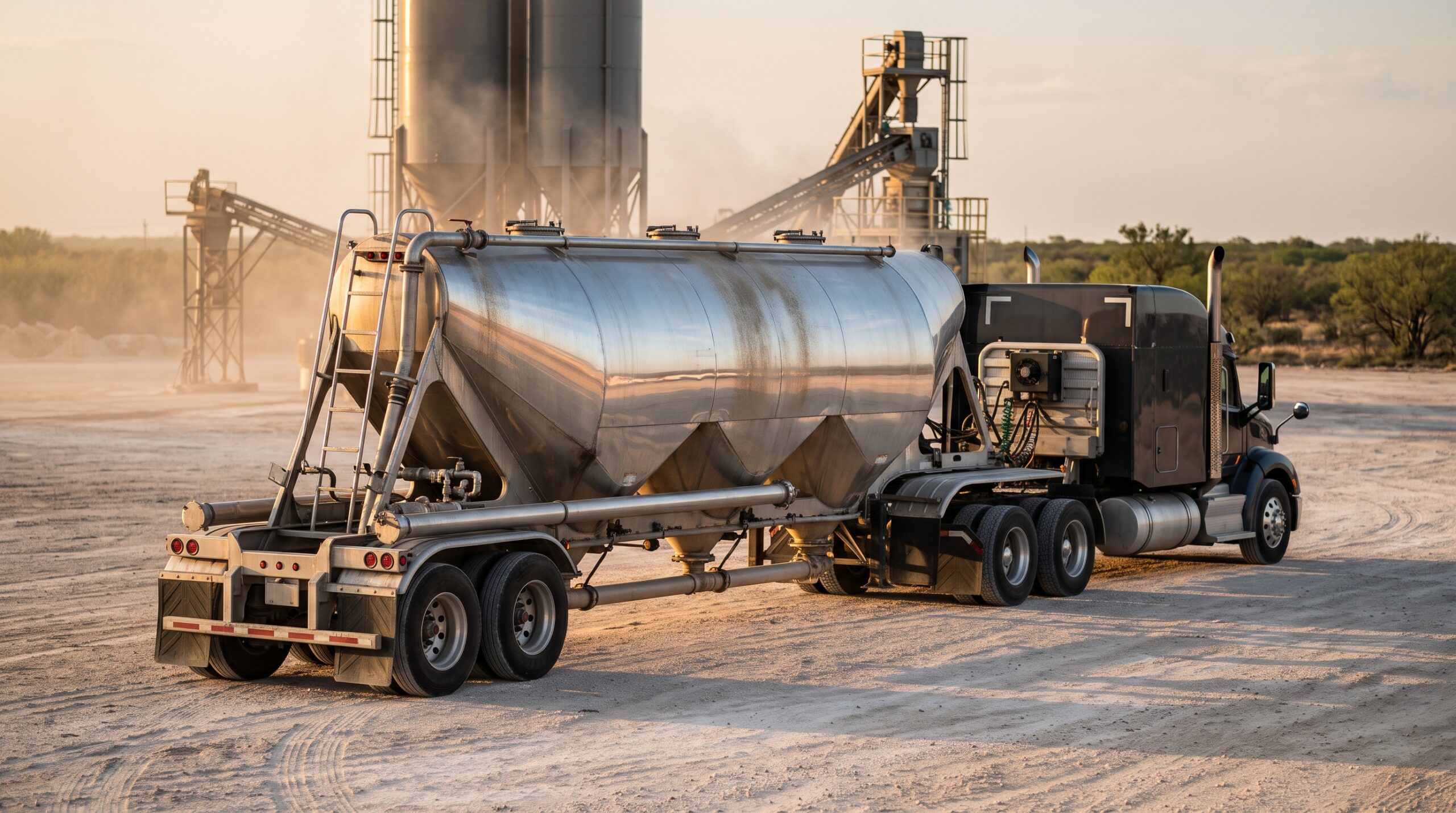
Their pneumatic lineup includes the 1000C, 1050C, 1250, and 1600 models. For frac sand hauling, the 1050C is the workhorse: 1,050 cubic feet of capacity, 42-foot length, 3-hopper design with 45-degree cone angles, SpinFlow™ aerators (three per hopper) for efficient unloading, 4-inch aluminum discharge lines, Hendrickson Intraax suspension, and polished aluminum wheels. The Tiremaax Pro tire inflation system comes standard on all axles.
Mac Trailer explicitly markets their pneumatic units as “ultralight” designs — engineered to maximize payload within legal weight limits. That’s not marketing language. That’s the spec philosophy that determines how many tons of sand you can legally haul per load, which determines your weekly revenue ceiling.
Pricing is transparent: a 2026 Mac 1050C Pneumatic Dry Bulk lists at $74,999 new. Used Mac pneumatics in Texas range from $24,000 to $144,500 depending on age, condition, and spec. If you’re buying used, ask what the trailer last hauled — a tanker that ran cement needs a wash-out before it can haul frac sand. Mac has active dealer presence in Dallas, Bryan, and Kyle — making parts and service support accessible across Texas. For a deeper look at new vs. used pneumatic trailer economics for frac sand, the ROI calculation shifts significantly based on your financing situation.
Load King vs. Mac Trailer: Head-to-Head Comparison
A 500-pound difference in tare weight is 500 more pounds of sand you can legally carry on every load. Run around 20 loads a week and that’s roughly 10,000 extra pounds — about 5 tons. At industry pneumatic rates of $27–$40 per ton, that’s roughly $135–$200 per week, or about $7,000–$10,400 per year in added gross revenue before your carrier split. For Owner-Operators, this is real money — and it compounds across the life of the trailer.
| Spec / Factor | Load King | Mac Trailer |
|---|---|---|
| Headquarters | Kansas City, MO (CTOS brand); mfg in Elk Point, SD | Alliance, OH; mfg in OH, MI, MT |
| Pneumatic Product Line | Not prominently published; custom/dealer inquiry required | 1000C, 1050C, 1250, 1600 — publicly listed with specs |
| Ultralight Design Focus | Not explicitly marketed for pneumatic units | Core design philosophy — explicitly marketed |
| Body Material | Aluminum available (not confirmed for pneumatic line) | Aluminum — standard on pneumatic units |
| Hopper Design | Not published for pneumatic units | 3-hopper, 45° cone, 3 aerators/hopper, SpinFlow™ |
| New Trailer Price (2026) | Not publicly listed for pneumatic units | $74,999 (1050C) |
| Used Market (Texas) | Limited visibility in regional listings | $24,000–$144,500; active TX dealer inventory |
| Texas Dealer Network | Present (Grand Prairie confirmed); pneumatic-specific coverage unclear | Dallas, Bryan, Kyle — active pneumatic inventory |
| O-O Forum Reputation (Pneumatic) | Positive for heavy-haul; pneumatic-specific data limited | Strong market presence; high dealer inventory turnover |
The honest bottom line: Mac Trailer wins on transparency. Their pneumatic product line is documented, priced, and stocked at Texas dealers. Load King may build an excellent pneumatic unit — but if you can’t find the specs, the pricing, or the used inventory, you can’t make an informed decision. When your livelihood depends on the trailer behind your truck, information gaps are a real cost. For a broader look at how pneumatic compares to bottom-drop for frac sand, the equipment choice ripples into every load you run.
Total Cost of Ownership: Financing, Maintenance & Hidden Costs
Purchase price is just the entry fee. The real question is what the trailer costs you over five years — and where the surprises hide.
Financing: New trailers typically qualify for 48–84 month terms; used units run 36–60 months. Prime borrowers (700+ credit, 3+ years in business) can access 5–9% APR. Subprime borrowers (below 620 FICO) should expect 18–35% APR — a spread that can cost you tens of thousands over the loan life. Most lenders require 10–20% down; highly qualified borrowers may find 0% down programs, while challenged credit may require 20–30% down.
Aluminum vs. Steel: Both Mac Trailer and Load King offer aluminum construction — and for frac sand hauling, aluminum is the right call. Corrosion resistance in oilfield conditions is non-negotiable, and the lighter tare weight directly translates to more payload per load. The trade-off: aluminum repairs run 40–145% more expensive than steel due to specialized tooling and labor. Plan for it. Budget a $3,000–$5,000 annual maintenance reserve for aluminum-specific upkeep — crack inspection, fastener checks, galvanic corrosion prevention.
Many Owner-Operators underestimate blower maintenance costs. A single blower motor replacement can run $5,000 — and if your blower fails mid-week, you lose 2–3 days of loaded miles while it’s being repaired. Budget $2,000–$3,000 annually for preventative maintenance. Skipping it doesn’t save money. It defers a larger, more painful bill.
Aluminum repairs are expensive, but they’re predictable. Set aside a maintenance reserve of $3,000–$5,000 annually for aluminum-specific repairs — fastener loosening, crack inspection, galvanic corrosion checks. This beats getting blindsided by a $10,000 repair bill when you can’t afford downtime.
Downtime is the cost nobody budgets for. Every day your trailer is in the shop is a day you’re not earning — while insurance, truck payments, and fixed costs keep running. The trailer brand that gives you faster parts access and better regional dealer support directly reduces your downtime risk. That’s a real dollar figure, not an abstraction. Understanding the real numbers behind Owner-Operator frac sand hauling means accounting for every cost — not just the ones on the sticker.
Regulatory, Licensing & Insurance Requirements for Pneumatic Bulk Hauling in Texas
Before you put either trailer on the road, you need to be compliant — and in the oilfield, compliance has more layers than standard commercial trucking.
- Driver requirements: Class A CDL with 2+ years of verifiable experience, age 23 or older, and a valid medical card at all times. Ask your carrier which endorsements they require for the freight you’ll haul.
- Texas weight limits: Standard federal axle limits apply — 20,000 lbs per single axle, 34,000 lbs for tandem. Oversize/overweight permits are required if you exceed 80,000 lbs GVWR on certain county roads.
- County permits: Permian Basin counties (Reeves, Loving, Midland, Ward) and Eagle Ford counties (Webb, La Salle) require heavy haul road use permits before you operate. Don’t skip this step.
- Oilfield certifications: PEC/Safeland (~$200), H2S training (~$20), and a respiratory fit test ($30–$50) are required for frac sand work because of silica dust exposure. Without them, you don’t get through the gate. At Sisu, cement hauling requires only the fit test.
- Annual inspection: Commercial trailers require Texas state safety inspections annually. Cargo tank inspection checklists are distinct from general trailer inspections — know the difference.
- Insurance: Commercial auto liability, cargo coverage, bobtail liability, trailer interchange (if leasing), and physical damage coverage are all standard. Newer, well-maintained trailers from reputable brands often command lower physical damage premiums.
For Owner-Operators new to the oilfield, the certification stack can feel overwhelming. The right carrier partner handles the compliance framework so you can focus on loaded miles. For a full breakdown of what oilfield trucking training and certifications look like in 2026, the investment is smaller than most drivers expect.
Why Sisu Energy Is the Right Choice for Pneumatic Owner-Operators
You’ve done the equipment research. You know the specs, the pricing, and the hidden costs. Now the question is: who do you run with?
Sisu Energy is a 100% Owner-Operator carrier with zero company trucks — which means no internal competition for loads, no escrow holds eating into your take-home, and no carrier that benefits from keeping you busy on their terms instead of yours. Six hauling divisions across Texas and Pennsylvania/Ohio — STX Hopper Bottom, STX Pneumatics, WTX Bottom Drop, NTX Pneumatics (cement), Houston Pneumatics (cement), and PA/OH Pneumatics — let you pick the region, hauling type, and schedule that fits your life. If your situation changes, you move divisions. You don’t leave the company.
24/7 live human dispatch with a rotary load distribution system means fair, consistent dispatch — not a dispatcher who favors whoever calls first. Motive ELD and Ditat load management handle the tech side. The human side stays human. Weekly Friday direct deposit, fuel cards with no fees, a 10–12% fuel discount off market rate, insurance programs, and plates available through Sisu mean your take-home is protected at every deduction point.
If you’re running a pneumatic trailer, Sisu has four divisions built for it: frac sand in South Texas (south of San Antonio to Laredo) and Pennsylvania/Ohio, and cement in Dallas/Fort Worth and Houston. STX Pneumatics requires oilfield experience (or a $300 trainer fee). Switching between cement and frac sand means a wash-out first, so pick the division that matches how you want to run. Whether you’re evaluating a Mac Trailer 1050C or deciding between new and used, the carrier you choose determines whether that equipment actually pays off. For Owner-Operators who want to understand how load rates vs. turns affect frac sand hauling profitability, the carrier’s load distribution model is just as important as the trailer spec.
Apply Today and join a Pack that respects your business and your bottom line.
Frequently Asked Questions
What is the most important factor for maximizing payload in a pneumatic frac sand trailer?
Tare weight is the single most critical factor. Lightweight aluminum construction allows you to carry more tons of sand per load within legal weight limits, directly multiplying your weekly revenue. Both Load King and Mac Trailer offer aluminum options, but Mac Trailer explicitly markets “ultralight” designs as a core differentiator — and that philosophy is baked into their engineering, not just their marketing copy. Every pound you shave from the trailer is a pound of sand you can legally haul.
How do aluminum vs. steel bodies impact pneumatic trailer ownership costs?
Aluminum offers superior corrosion resistance and a lighter tare weight — both critical for oilfield frac sand hauling. The lighter weight enables higher payloads and better fuel efficiency over time. The trade-off is repair cost: aluminum repairs run 40–145% more expensive than steel due to specialized equipment and training requirements. Steel is cheaper to repair upfront but heavier and prone to rust in oilfield conditions. For most operators running high-turn regional frac sand lanes, aluminum’s long-term payload and efficiency advantages outweigh the higher repair costs — provided you budget for them in advance.
How often should a pneumatic trailer’s blower and air system be maintained?
The blower is the heart of your pneumatic system and cannot be neglected. Budget $2,000–$3,000 annually for routine preventative maintenance — oil changes, belt inspections, pressure checks, and valve servicing. A single blower motor replacement runs approximately $5,000, and a mid-week failure costs you 2–3 days of loaded miles on top of the repair bill. Hoses, seals, and gaskets are wear items that need frequent inspection — costs range from a few dollars for small fittings to several thousand for major components. Treat blower maintenance like a truck payment: it’s a fixed cost of doing business.
Is pneumatic frac sand hauling more profitable than hopper bottom hauling?
It can be, but it depends. Industry rates currently run about $27–$40 per ton for pneumatic versus $18–$23 per ton for bottom drop, and a typical load runs 23–25 tons. Pneumatic’s higher rate comes with higher costs: blower maintenance, wash-outs when switching materials, a required ELD, and often a different carrier split (at Sisu, 80/20 for pneumatic versus 85/15 for bottom drop). Fuel surcharges and detention pay can add to either, but not every customer pays them — ask your carrier which ones do. Run the numbers for your truck, your lane, and your costs before assuming the higher per-ton rate means higher take-home.
Why should I choose Sisu Energy over other pneumatic bulk carriers?
Sisu Energy is built 100% Owner-Operator first — no company trucks, no internal load competition, and no escrow holds eating into your take-home. You get 24/7 live human dispatch with a fair rotary load distribution system, weekly Friday direct deposit, minimal deductions, and the flexibility to move between six divisions (STX Hopper Bottom, STX Pneumatics, WTX Bottom Drop, NTX Pneumatics, Houston Pneumatics, and PA/OH Pneumatics) as your life changes. The fuel program runs a 10–12% discount off market rate, onboarding is fast with no orientation required, and your success is our success — that’s not a tagline, it’s the business model. Apply Today and join a Pack that respects your business.
Ready to Put Your Pneumatic Rig to Work?
You’ve done the homework on Load King vs. Mac Trailer — now pair that equipment decision with a carrier that’s built around your take-home, not theirs. Sisu Energy’s pneumatic divisions run frac sand in South Texas and Pennsylvania/Ohio and cement in Dallas/Fort Worth and Houston, with 24/7 live human dispatch and zero company-truck competition for your loads.
*Sisu Energy LLC contracts exclusively with independent Owner-Operators. Earnings vary by division, miles, fuel costs, and individual business factors, and no specific income is guaranteed. Programs, lease rates, and requirements are subject to change. Please contact Sisu Energy directly for current opportunities and division details.