Owner Operator Frac Sand Trucking Taxes: Deductions, IFTA & Quarterly Filing
- As a 1099 owner-operator, you owe federal income tax, self-employment tax (15.3% on the first ~$168,600 net), IFTA fuel taxes, and annual Heavy Vehicle Use Tax — none of it is withheld, so quarterly estimated payments are non-negotiable.
- Schedule C deductions — fuel, depreciation, insurance, ELD fees, per diem, trailer rental, and compliance costs — can dramatically reduce your taxable income; a driver qualifying for per diem 250 days per year saves $3,000+ in taxes at a 22% bracket alone.
- Any commercial vehicle over 26,000 lbs that crosses into another state — including Texas to New Mexico in the Permian Basin — is legally required to carry an IFTA license and file quarterly returns by April 30, July 31, October 31, and January 31.
- Business structure matters: sole proprietors file Schedule C, single-member LLCs are treated the same for taxes, and S-Corp election typically saves meaningful self-employment tax only when annual net profit consistently exceeds $80,000.
- Trust Sisu Energy for 100% owner-operator pay transparency, weekly Friday direct deposit, and Motive ELD mileage tracking that keeps your IFTA records audit-ready — visit Sisu Energy to learn how the Pack is built around your business.
What taxes do owner-operator frac sand truckers actually owe, and how do you file them correctly?
As a 1099 owner-operator, you’re responsible for federal income tax, self-employment tax (15.3%), IFTA fuel tax filings, and Heavy Vehicle Use Tax — all paid quarterly or annually, with deductions available for fuel, depreciation, insurance, and compliance costs. Unlike a W-2 employee, no taxes are withheld from your pay, making disciplined quarterly filing and expense tracking essential to avoid penalties and maximize your take-home. This guide walks you through every deduction, filing deadline, and compliance requirement specific to frac sand hauling in the Permian Basin and beyond.
Understanding your real tax obligations — and what you can legally deduct — is the foundation of running a profitable trucking business.
Sisu Energy
100% Owner-Operator — You Never Compete With Company Trucks
Core Service Programs:
- Pneumatic Frac Sand Hauling for owner-operators running STX and PA/OH oilfield lanes
- Hopper Bottom Frac Sand Hauling for owner-operators across the Permian, West Texas, and South Texas
- Cement Hauling for owner-operators running Monday–Friday daytime lanes in North Texas and Houston
Why Choose Sisu Energy:
- ✓ 100% Owner-Operator fleet — you never compete with company trucks for loads
- ✓ 24/7 live human dispatch with a fair rotary load distribution system
- ✓ No escrow, no fuel card fees, and minimal deductions
- ✓ Weekly direct deposit, paid every Friday
- ✓ Fuel program with a 10–12% discount off market rate
- ✓ Fast, streamlined onboarding — no orientation required
The Owner-Operator Tax Structure: 1099 vs. W-2 and Why It Matters
When you sign on as a 1099 contractor, you are running a small business — full stop. Every dollar Sisu pays you lands in your account as gross revenue with zero federal or state tax withheld. That’s the upside of independence. The flip side is that you’re solely responsible for calculating and remitting federal income tax, self-employment tax, and any applicable state taxes on your own schedule.
A W-2 employee has their employer split the Social Security and Medicare burden — each side pays 7.65%. As a 1099 operator, you cover both halves: the full 15.3% self-employment tax on top of ordinary income tax. That’s the price of being your own boss, and it’s manageable once you understand the math. The good news is that your business structure gives you tools a W-2 worker never gets — the ability to deduct every legitimate business expense before calculating what you owe.
Multi-state hauling adds another layer. The moment your rig crosses from Texas into New Mexico on a Permian run, you’ve triggered IFTA fuel tax obligations and need to track income and expenses by jurisdiction. Income volatility compounds the challenge — a driver might gross $10,000 one week and $3,000 the next depending on weather, well-site delays, or rig moves. That’s why basing quarterly estimated tax payments on your actual income each quarter — rather than dividing last year’s tax by four — is the safer approach. For a deeper look at what real Permian Basin earnings look like before taxes hit, see owner-operator frac sand hauling real numbers.
Schedule C Deductions: What You Can Actually Write Off
Every deductible expense you claim on Schedule C reduces your taxable income dollar-for-dollar before self-employment tax is calculated. That’s leverage. Here’s what’s on the table under IRC Section 162 for frac sand owner-operators:
- Truck-related costs: depreciation, loan interest, repairs, tires, maintenance, and washing
- Fuel: actual diesel, oil, and DEF costs — if you use a fuel card with a discount, the deductible amount is the net price you paid
- Insurance: non-trucking liability, occupational accident, physical damage, and cargo/trailer interchange
- Compliance and safety: ELD service fees (Motive), drug testing, PEC/Safeland training, H2S certification, and required PPE (hard hat, steel-toe boots, respirators)
- Fees and taxes: HVUT (Form 2290), IFTA taxes paid, license plates, registration fees, and permits
- Trailer rental: the $350/week WTX hopper bottom lease is fully deductible as a rental expense
- Professional services: accounting, bookkeeping, and tax prep fees — a qualified CPA or EA typically runs $750–$2,000 per year and is itself deductible
- Home office: if you maintain a dedicated space for dispatch calls, load planning, and administrative work, the simplified method allows $5/sq ft up to 300 sq ft ($1,500/year)
Many owner-operators miss the per diem deduction because they don’t realize they qualify. If you stay in your sleeper cab overnight or take a 34-hour reset, you likely qualify for the 80% transportation worker per diem — worth $13,800+ annually for frequent haulers.
Truck Depreciation and Section 179 / Bonus Depreciation
Your truck is likely your largest single asset — and the IRS gives you powerful tools to deduct it fast. Section 179 allows you to deduct the full purchase price of a new or used truck in the year you place it in service, up to $1,220,000 (2024 limit, indexed annually). That’s an immediate write-off rather than spreading the deduction over years.
Bonus depreciation works differently — it’s a percentage of the asset’s cost taken in year one on top of standard depreciation. For 2025, bonus depreciation was 40%. For 2026, it drops to 20%. If you’re considering a truck purchase, the timing relative to year-end matters — a truck placed in service before December 31 generates a first-year deduction that a January purchase delays by a full year. Standard MACRS depreciation for Class 8 heavy trucks runs over three years when Section 179 is not elected.
Per Diem Deduction for Transportation Workers
The IRS standard meal and incidental expense rate is $69 per full day (2024 rate). Transportation workers — including owner-operators — can deduct 80% of that amount when they’re away from their tax home substantially longer than an ordinary workday and need sleep or rest. A driver who stays in their sleeper cab overnight or takes a 34-hour reset qualifies. A driver who returns home every night does not.
The math is compelling: a driver qualifying 250 days per year deducts $69 × 0.80 × 250 = $13,800. At a 22% tax bracket, that’s over $3,000 in annual tax savings — from a deduction many operators overlook entirely.
IFTA Quarterly Filing: Multi-State Fuel Tax Compliance
IFTA — the International Fuel Tax Agreement — exists to simplify fuel tax reporting for interstate carriers. Instead of filing separately with every state you drive through, you file one quarterly return with your home state (Texas), which then distributes the appropriate taxes to each jurisdiction. Simple in concept, detail-intensive in practice.
You’re required to have an IFTA license if your vehicle has two axles and a gross weight over 26,000 lbs — or three or more axles regardless of weight — and operates in at least two IFTA jurisdictions. Every Permian Basin driver running loads into New Mexico meets this threshold. The license is obtained through the Texas Department of Motor Vehicles and must be renewed annually.
The IRS and IFTA auditors most commonly find inadequate mileage records, resulting in unfavorable assessments. Use an ELD like Motive to automatically log miles and generate audit-ready reports.
IFTA quarterly deadlines are fixed — missing them triggers a penalty of $50 or 10% of net tax due (whichever is greater), plus interest. Keep all IFTA records for four years: trip reports with routes, dates, and odometer readings, plus all fuel receipts. ELD data from Motive is accepted by auditors and eliminates the manual log burden entirely.
| Quarter | Period Covered | Filing Deadline | Late Penalty (TX) |
|---|---|---|---|
| Q1 | January – March | April 30 | $50 or 10% of net tax due + interest |
| Q2 | April – June | July 31 | $50 or 10% of net tax due + interest |
| Q3 | July – September | October 31 | $50 or 10% of net tax due + interest |
| Q4 | October – December | January 31 | $50 or 10% of net tax due + interest |
The IFTA calculation itself requires tracking total miles driven and total fuel purchased in each state for the quarter. Your overall fleet MPG is calculated (total miles ÷ total gallons), then applied to miles driven in each jurisdiction to determine how much fuel was “consumed” there. If you purchased less fuel in New Mexico than your NM miles would imply you consumed, you owe NM the difference — paid through your Texas IFTA return. To understand how fuel pricing programs affect your actual deductible fuel costs, see retail-minus vs. cost-plus fuel pricing for owner-operators.
Federal Estimated Tax and Self-Employment Tax: Quarterly Payments and Calculations
The IRS requires self-employed individuals to pay taxes as they earn — not in one lump sum in April. Federal estimated tax payments are due four times per year: April 15, June 15, September 15, and January 15 of the following year. Miss them and you face an underpayment penalty even if you pay everything owed by the April filing deadline.
To avoid penalties, you must pay either 90% of your current year’s tax liability or 100% of the prior year’s tax (110% if your prior year adjusted gross income exceeded $150,000). Given the income swings common in frac sand hauling — loads ranging from $850 to $1,200 each, with volume varying week to week — calculating your actual net income each quarter and annualizing it is the most accurate method.
Frac sand hauling income swings from $3,000 to $10,000+ per week depending on weather, well-site delays, and rig moves. This volatility is why annualized quarterly estimated tax payments (based on actual income earned that quarter) are safer than dividing last year’s tax by four.
Self-employment tax for 2026 is 15.3% on the first ~$168,600 of net earnings — 12.4% for Social Security and 2.9% for Medicare. Above that threshold, only the 2.9% Medicare rate applies. One-half of your SE tax paid is deductible on Form 1040, which reduces your overall taxable income.
Here’s what SE tax looks like at different income levels:
- $60,000 net profit: ~$8,478 SE tax
- $100,000 net profit: ~$14,130 SE tax
- $150,000 net profit: ~$21,200 SE tax
The practical rule: set aside 25–30% of your net income (gross pay minus business expenses) each week into a dedicated savings account. When quarterly deadlines hit, the cash is there. With Sisu’s weekly Friday direct deposit, you can build this habit into your routine from day one.
Heavy Vehicle Use Tax (Form 2290) and Annual Compliance
Form 2290 — the Heavy Vehicle Use Tax — is an annual federal tax on any highway vehicle with a gross weight of 55,000 lbs or more. For most Class 8 trucks over 75,000 lbs, the tax is $550 per year. The filing deadline is August 31 for vehicles first used during July of that tax year.
HVUT compliance is effectively self-enforcing: the IRS issues a stamped Schedule 1 as proof of payment, and state DMVs require that document to register your truck. You cannot legally operate without registration, so the compliance chain is tight. The IRS collects over $1.5 billion annually from HVUT — this is a heavily monitored tax with a built-in enforcement mechanism. File it on time, keep your stamped Schedule 1 in the cab, and it’s a non-issue.
Business Structure Strategy: Sole Proprietor, LLC, or S-Corp?
Most owner-operators start as sole proprietors — you report income and expenses on Schedule C, which flows directly into your personal Form 1040. It’s the simplest structure and costs nothing to maintain. Many drivers eventually form a single-member LLC for liability protection, which is a smart move, but it doesn’t change how you’re taxed: the IRS treats a single-member LLC as a “disregarded entity” and you still file Schedule C.
The S-Corp conversation becomes relevant when your annual net profit consistently clears $80,000. Here’s why: an S-Corp pays you a “reasonable salary” (say, $60,000 on $120,000 net profit), and the remaining $60,000 is distributed as a shareholder distribution — which is not subject to self-employment tax. On $60,000 in distributions, that saves over $9,000 in SE taxes annually. The administrative cost — payroll service, separate corporate tax return — runs $1,500–$3,000 per year. The math works. Below $80,000 net, the savings often don’t justify the overhead.
If you’re operating in Texas as an LLC or S-Corp, the state franchise tax has a “no tax due” threshold of $2.47 million in revenue (2024–2025 figures). A single-truck owner-operator files a No Tax Due Report annually — no payment required. Consult a CPA or enrolled agent who specializes in transportation before making any structure change; the right answer depends on your specific income level and trajectory. For a broader look at how carrier selection affects your take-home, see whether frac sand hauling is worth it in 2026.
Why Sisu Energy Is the Right Choice for Permian Basin Owner-Operators
Tax planning as an owner-operator is only half the equation — the other half is choosing a carrier that doesn’t erode your earnings before you ever get to the IRS. Sisu Energy operates as a 100% owner-operator carrier with zero company trucks. That means no internal competition for loads, no hidden escrow holds eating into your cash flow, and weekly Friday direct deposit so you have money in hand when quarterly tax payments come due.
Sisu’s 24/7 live human dispatch with rotary load distribution keeps your loaded miles consistent — which directly reduces income volatility and makes your quarterly tax calculations more predictable. Six hauling divisions across Texas and Pennsylvania/Ohio give you options: maximize miles in the Permian Basin, run Mon–Fri daytime cement lanes in North Texas, or haul pneumatic frac sand in South Texas. Your division, your schedule, your tax strategy.
On the compliance side, Sisu’s partnership with Motive ELD means your mileage and fuel data are automatically logged and audit-ready. When IFTA filing season hits, your records are already organized. When your CPA asks for Schedule C documentation, your ELD reports do the heavy lifting. That’s time and money saved — and it reduces your audit exposure on the most commonly flagged item: inadequate mileage records.
Join Our Pack and take control of your trucking business and your taxes — Apply Today.
Frequently Asked Questions: Owner-Operator Frac Sand Trucking Taxes
I get a 1099, so does that mean I can write off everything?
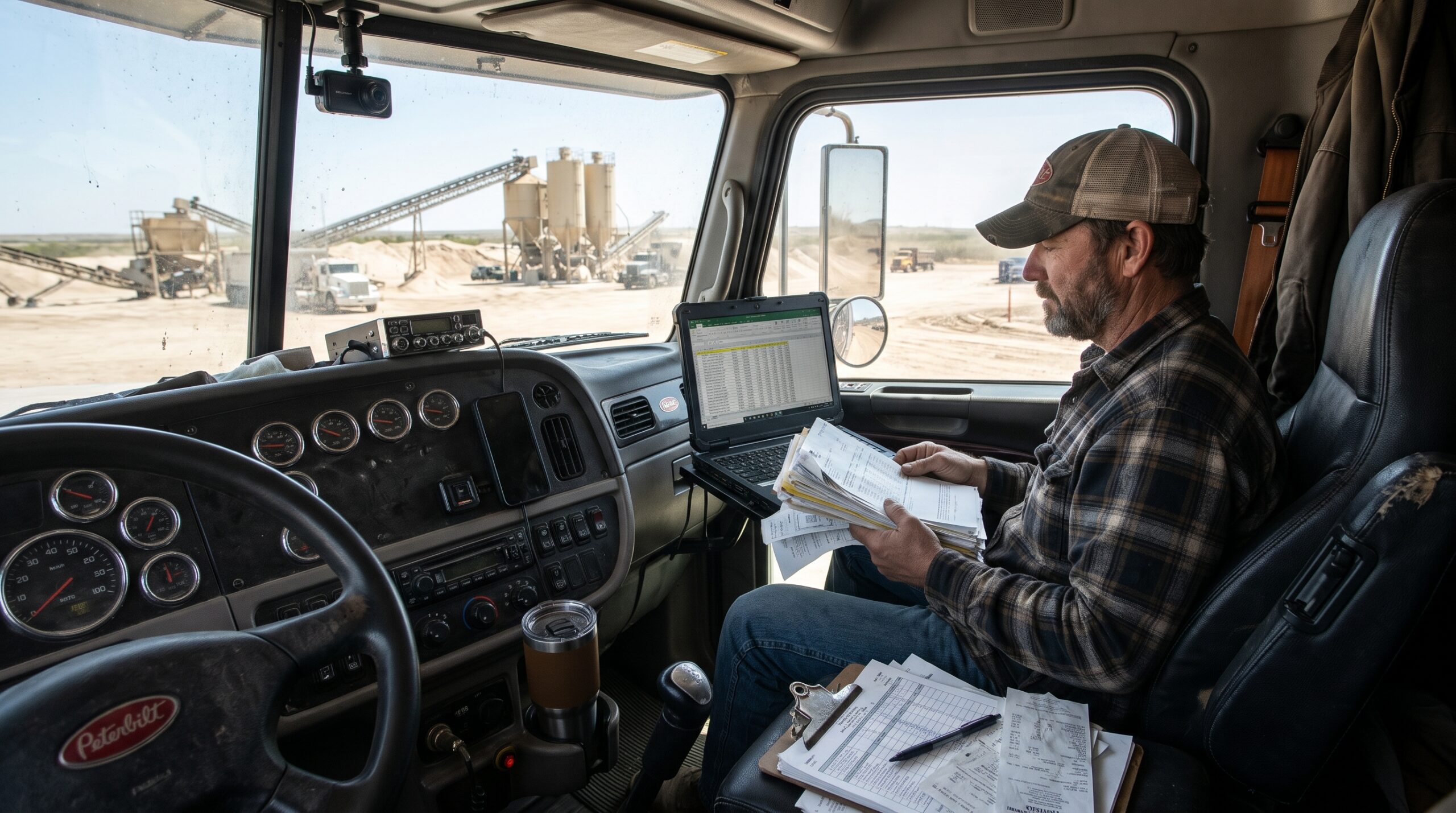
As a 1099 contractor, you can deduct all “ordinary and necessary” business expenses directly related to running your trucking operation — fuel, insurance, repairs, depreciation, and compliance costs all qualify. Personal expenses like groceries, home utilities, or non-work clothing are not deductible. The key is that every expense must be business-related and backed by documentation: receipts, bank statements, or canceled checks. Paying in cash makes this documentation difficult and raises audit risk — use a dedicated business bank account and debit or credit card for all business purchases to create a clean paper trail.
How do I prove my expenses if I pay for everything in cash?
Paying in cash is the fastest way to create an audit problem. The IRS requires proof of payment — receipts, bank statements, or canceled checks — for every deduction you claim on Schedule C. Without that documentation, a deduction can be disallowed entirely during an audit, and you’ll owe back taxes plus interest and penalties. The fix is straightforward: open a dedicated business checking account and run all business expenses through it. Your bank statement becomes your primary record, and your CPA’s job gets significantly easier and less expensive.
I only run between Texas and New Mexico. Do I really need to do IFTA?
Yes — no exceptions. The moment your commercial vehicle over 26,000 lbs crosses a state line into any IFTA jurisdiction, you are legally required to carry an IFTA license and file quarterly returns. The threshold is not based on how many states you operate in; it’s triggered by crossing any state line at all. Failure to file in Texas carries a penalty of $50 or 10% of net tax due — whichever is greater — plus interest, and non-compliance can affect your ability to register your truck for the following year.
How much should I set aside for taxes each week?
The standard rule for owner-operators is to set aside 25–30% of your net income — gross pay minus business expenses — into a separate savings account each week. This covers federal income tax and self-employment tax combined. With quarterly estimated payments due on April 15, June 15, September 15, and January 15, building this habit weekly prevents the cash flow shock that catches new operators off guard. Given the income swings common in frac sand hauling, the conservative end of that range (30%) gives you a buffer when a slow week follows a strong one.
What makes Sisu Energy different from other frac sand carriers when it comes to managing my taxes and take-home pay?
Sisu is built 100% owner-operator first — no company trucks, no escrow holds, and weekly Friday direct deposit. That structure means you have predictable cash flow to set aside for quarterly tax payments and keep more of what you earn. Sisu’s 24/7 live human dispatch with rotary load distribution ensures consistent loaded miles, reducing the income volatility that makes quarterly tax calculations unpredictable. Sisu’s partnership with Motive ELD automatically tracks your mileage and fuel records, keeping your IFTA filings and Schedule C documentation audit-ready without extra work on your end. Take control of your business and your taxes — Join Our Pack and Apply Today.
Ready to Run Taxes Like a Business Owner in the Permian Basin?
You’ve got the tax knowledge — now pair it with a carrier that’s built to maximize your take-home. Sisu’s 100% owner-operator model, weekly Friday direct deposit, and Motive ELD integration give you the cash flow and records you need to stay compliant and profitable. No company trucks. No escrow. Just your business, your loads, and your future.
*Sisu Energy LLC contracts exclusively with independent Owner-Operators. Earnings vary by division, miles, fuel costs, and individual business factors, and no specific income is guaranteed. Programs, lease rates, and requirements are subject to change. Please contact Sisu Energy directly for current opportunities and division details.