Mack vs. Freightliner Heavy Haul Sand Transport for Commercial Comparison
- Frac sand demand in the Permian Basin is projected to exceed 35 million tons in 2026, with 241 active rigs accounting for 44.4% of all U.S. drilling activity — making truck selection a direct income decision, not just a preference.
- A 0.5 MPG fuel economy difference compounds to $10,900+ per year at current Gulf Coast diesel prices ($3.784/gallon, May 2026) — small efficiency gaps become large dollar gaps over a full hauling season.
- Freightliner holds a clear advantage in service network density across West Texas and the Permian Basin; Mack Granite holds a perceived edge in vocational chassis durability for extreme-duty oilfield conditions.
- An unplanned out-of-service day costs a Permian Basin Owner-Operator $1,000–$1,800+ in lost gross revenue — which means parts availability and dealer proximity are as important as purchase price in your total cost calculation.
- Trust Sisu Energy for Owner-Operator-first dispatch, 24/7 live human support, and Permian Basin loads that maximize your take-home — join the Pack and apply now to put your truck to work.
Mack vs. Freightliner Heavy Haul Sand Transport: Which Truck Maximizes Your Permian Basin Income?
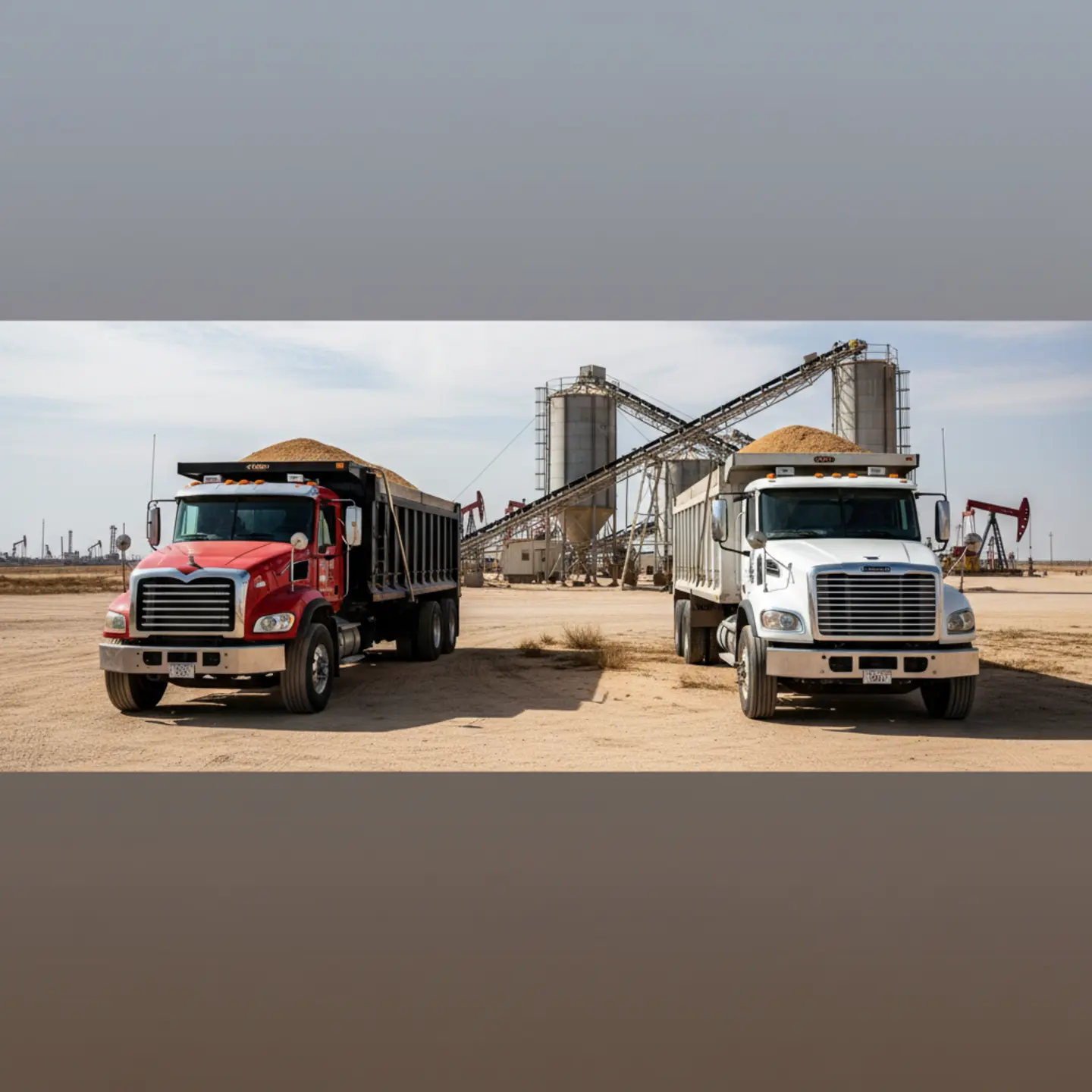
For frac sand hauling in the Permian Basin, the choice between Mack Granite and Freightliner 122SD comes down to two competing priorities: Mack’s vocational durability and lower long-term structural maintenance costs versus Freightliner’s unmatched service network density and quicker repair turnaround. Both platforms deliver the horsepower and payload capacity needed for heavy haul work, but they optimize for different Owner-Operator pain points. The right choice depends on whether you prioritize chassis longevity or uptime—and how far you are from a certified service center.
To help you make the decision that protects your income and your investment, we’ve broken down total cost of ownership, real-world fuel economy, maintenance patterns, and the regulatory landscape specific to West Texas and the Permian Basin.
100% Owner-Operator — You Never Compete With Company Trucks
Core Service Programs
- Pneumatic Frac Sand Hauling for owner-operators running STX and PA/OH oilfield lanes
- Hopper Bottom Frac Sand Hauling for owner-operators across the Permian, West Texas, and South Texas
- Cement Hauling for owner-operators running Monday–Friday daytime lanes in North Texas and Houston
Why Choose Sisu Energy
- ✓ 100% Owner-Operator fleet — you never compete with company trucks for loads
- ✓ 24/7 live human dispatch with a fair rotary load distribution system
- ✓ No escrow, no fuel card fees, and minimal deductions
- ✓ Weekly direct deposit, paid every Friday
- ✓ Fuel program with a 10–12% discount off market rate
- ✓ Fast, streamlined onboarding — no orientation required
Oilfield Trucking Market Context: Permian Basin Demand & Owner-Operator Economics
The Permian Basin is the undisputed king of U.S. fracking activity right now. With 241 active rigs as of May 2026 — representing 44.4% of all U.S. drilling — and frac sand demand projected to exceed 35 million tons in 2026, the basin is running at full intensity. E&P operators are pushing longer lateral lengths and higher sand intensity per well, which means more loads per completion, more trucks needed, and more opportunity for Owner-Operators who are properly equipped.
The shift to in-basin sand sourcing since 2023 has fundamentally changed the math. Texas produced approximately 30 million tons of in-basin frac sand in 2023, dramatically cutting haul distances compared to Northern White Sand imports from Wisconsin. Shorter runs mean more load turns — productive Owner-Operators in the Permian are completing 17–22 loads per week and grossing $5,000–$9,000+ weekly at current contract rates of $2.50–$4.50/mile. Spot rates can reach $3.00–$6.00+/mile when demand spikes.
There’s also a recognized driver shortage in Permian frac sand hauling — and that shortage is your leverage. Qualified Owner-Operators have genuine negotiating power with carriers and shippers right now. Demand peaks in Q1/Q2 as E&P operators front-load spending, with secondary spikes in fall. What this means for your truck choice: downtime is catastrophic. An unplanned out-of-service day costs $1,000–$1,800+ in lost gross revenue. Every hour your truck is in a shop instead of on a load lane is money you’ll never recover.
For a deeper look at how frac sand hauling rates and load turns in the Permian translate to real weekly income, the numbers break down clearly by haul type and division.
Total Cost of Ownership: Purchase Price, Fuel Economy & Maintenance Over 500,000 Miles
The sticker price is the least important number in this comparison. What matters is what each platform costs you over 500,000 miles of Permian Basin sand hauling — and how those costs compound into the difference between a profitable operation and a break-even grind.
An unplanned out-of-service day costs an Owner-Operator $1,000–$1,800+ in lost gross revenue. This is why service network density and parts availability matter as much as initial purchase price — every hour your truck is down is money out of your pocket.
New purchase prices: Mack Granite heavy haul spec runs $160,000–$220,000 MSRP. Freightliner 122SD comes in at $180,000–$240,000 MSRP. In the used market (3–7 years old), Mack lands at $60,000–$120,000 and the 122SD at $70,000–$130,000. Auction and private market prices can run 10–20% lower, but come with increased risk on condition and maintenance history.
Engine rebuild costs are comparable across platforms. Mack MP8/MP10 rebuilds run $20,000–$40,000+; Detroit DD15/DD16 rebuilds run $20,000–$45,000+. In high-duty-cycle sand hauling, expect major overhaul intervals in the 500,000–700,000 mile range for both. Labor rates at West Texas shops (Midland/Odessa) run $120–$180+/hour — so faster diagnosis and repair from a denser service network translates directly to lower total repair bills, not just less downtime.
Fuel Economy Compounding: Why 0.5 MPG Matters Over a Year
Real-world loaded MPG for both platforms in Permian Basin conditions: Mack Granite runs 4.0–5.5 MPG fully loaded; Freightliner Cascadia runs 4.5–6.0 MPG loaded; the 122SD (more vocational) runs closer to the Granite’s range at 4.0–5.5 MPG. In stop-and-go oilfield conditions with significant idle time and short hauls, actual MPG is lower than highway averages for both.
Here’s where it gets real: at a conservative 2,500 loaded miles/week, a 0.5 MPG difference equals 55.5 gallons saved per week. At Gulf Coast diesel prices of $3.784/gallon (EIA, May 20, 2026), that’s approximately $210/week — or $10,900+ annually — in the more efficient truck’s pocket. Over 17–22 loads per week with significant idle time, the impact of even marginal efficiency gains is magnified. Don’t dismiss a half-MPG difference as rounding error.
Maintenance Durability: Mack’s Vocational Chassis vs. Freightliner’s Service Network
Maintenance cost per mile in heavy haul oilfield service runs approximately $0.25–$0.40/mile for both platforms — well above the Class 8 average of ~$0.21/mile (ATRI, 2023 data). Brakes, suspension, axles, and frame components all take a beating from constant heavy loads and rough oilfield roads.
Mack Granite’s vocational chassis and suspension are purpose-built for this abuse, and operators consistently report slightly lower structural wear over time in extreme-duty applications. Freightliner’s 122SD is also a severe-duty platform — it’s not a highway Cascadia forced into oilfield work — but Freightliner’s advantage is its parts distribution network and dealer density, which can offset any marginal maintenance cost difference by getting you back on the road faster and at more competitive labor rates.
| Feature | Mack Granite | Freightliner 122SD |
|---|---|---|
| Purchase Cost (New) | $160,000–$220,000+ | $180,000–$240,000+ |
| Purchase Cost (Used, 3–7 yr) | $60,000–$120,000+ | $70,000–$130,000+ |
| Loaded MPG (Oilfield) | 4.0–5.5 MPG | 4.0–5.5 MPG (122SD); 4.5–6.0 MPG (Cascadia) |
| Engine Rebuild Cost | $20,000–$40,000+ (MP8/MP10) | $20,000–$45,000+ (DD15/DD16) |
| Maintenance Cost/Mile (Heavy Haul) | ~$0.25–$0.40/mile | ~$0.25–$0.40/mile |
| Chassis Durability Edge | Slight advantage — purpose-built vocational frame | Competitive (122SD); offset by superior service network |
Regulatory & Compliance: GVW, Overweight Permits, CSA Scores & Insurance in Texas
Federal GVW limit is 80,000 lbs on interstates. In the Permian Basin, overweight permits (84,000+ lbs) are routine — counties like Midland, Ector, Reeves, Loving, Ward, and Pecos see constant heavy haul traffic, and permit costs run $50–$500+ per permit depending on weight increment and route. Annual permits offer economies of scale for frequent haulers.
Both Mack and Freightliner can be spec’d with optimized axle spacing and suspension to maximize legal payload within Texas GVW and bridge law limits. Work with your dealer to ensure your truck is configured for the heaviest legal loads — this directly increases your per-load revenue without regulatory risk.
Both Mack and Freightliner can be configured to maximize legal payload within bridge law constraints. The key is correct axle spacing, suspension selection, and fifth-wheel placement — not brand. A properly spec’d Granite and a properly spec’d 122SD will carry the same legal load.
FMCSA CSA scores are driven by roadside inspection violations — brakes, tires, lighting, suspension, steering, cargo securement — not by truck brand. No published data shows Mack or Freightliner having higher pass rates on Texas DPS commercial vehicle inspections. What drives your CSA score is your maintenance discipline, not your badge. Short-haul exemptions (150 air-mile radius, 14-hour on-duty window) may apply to many Permian Basin operations, reducing ELD burden for qualifying runs. Insurance requirements run $750,000–$1,000,000 primary liability and $100,000–$250,000 cargo liability; underwriting is driven by operation type and driver CSA score, not truck platform.
For a full breakdown of how equipment type affects compliance and pay structure, the comparison between bottom drop vs. pneumatic frac sand hauling covers the regulatory and operational differences in detail.
Head-to-Head: Mack Granite vs. Freightliner 122SD for Frac Sand Hauling
Constant exposure to frac sand causes accelerated wear on paint, undercarriage components, radiators, and electrical systems. Proactive maintenance, regular cleaning, and protective coatings are critical for both Mack and Freightliner to mitigate long-term damage and preserve resale value.
Mack Granite: Strengths & Weaknesses for Permian Heavy Haul
The Granite is Mack’s purpose-built vocational workhorse. Its MP8 (400–505 HP, 1,460–1,860 lb-ft) and MP10 (515–605 HP, 1,860–2,060 lb-ft) engines are built for high-cycle, high-torque duty. The frame, axles, and suspension are engineered to absorb the punishment of repeated heavy loading on rough oilfield roads — and Owner-Operators consistently praise it for exactly that. Strong brand loyalty in vocational segments, and Mack’s GuardDog Connect telematics help with proactive monitoring.
Weaknesses: Fuel economy on longer unloaded runs can lag behind more aerodynamic competitors. Cab ergonomics and interior amenities are functional but less refined than the Cascadia — relevant if you’re running long shifts. Mack’s dealer network in West Texas is solid but not as dense as Freightliner’s, which matters when you’re 80 miles from Odessa with a brake issue.
Freightliner 122SD: Strengths & Weaknesses for Permian Heavy Haul
The 122SD is Freightliner’s answer to severe-duty vocational work — not a highway Cascadia with heavier springs, but a purpose-built platform with reinforced frame rails, heavy-duty vocational suspensions (TufTrac, Chalmers), and the DD15 (400–505 HP, 1,550–1,850 lb-ft) or DD16 (500–600 HP, 1,850–2,050 lb-ft) powering it. Freightliner holds 39.2% of Class 8 retail sales in North America (Daimler Truck North America, 2024 data) — that market dominance translates directly into parts availability and dealer density that no other brand can match in West Texas.
Weaknesses: The 122SD commands a higher MSRP than the Granite at the top end of heavy-duty specs. Like all trucks in this environment, it’s vulnerable to sandblasting damage on undercarriage components, radiators, and electrical systems — proactive protection is non-negotiable for either platform.
Comparison Table: Mack Granite vs. Freightliner 122SD for Frac Sand Hauling
| Category | Mack Granite | Freightliner 122SD | Edge |
|---|---|---|---|
| Engine Options (HP/Torque) | MP8: 400–505 HP / 1,460–1,860 lb-ft MP10: 515–605 HP / 1,860–2,060 lb-ft |
DD15: 400–505 HP / 1,550–1,850 lb-ft DD16: 500–600 HP / 1,850–2,050 lb-ft |
Even |
| Vocational Chassis Durability | Purpose-built; strong structural reputation in extreme-duty oilfield use | Severe-duty platform; competitive, but Granite holds perceived edge | Mack |
| Service Network (West Texas) | Strong but less dense than Freightliner in Odessa/Midland area | Unmatched dealer density; most certified service points in West Texas | Freightliner |
| Parts Availability | Good (Volvo Group network); occasional longer lead times on niche parts | Excellent; high volume and commonality across Daimler network | Freightliner |
| Driver Comfort (Long Shifts) | Functional and robust; less refined interior than Cascadia | More ergonomic cab; modern amenities; quieter interior | Freightliner |
| Telematics / Remote Diagnostics | Mack GuardDog Connect — proactive health monitoring | Detroit Connect — advanced telematics and remote diagnostics | Even |
| Extended Warranty Coverage | GuardDog ESC — up to 5–7 yr / 750,000 mi | Detroit Protection Plan — up to 5–7 yr / 750,000 mi | Even |
| Abrasive Environment Resilience | Slight edge in undercarriage protection; proactive maintenance still required | Vulnerable like all platforms; faster service network catches issues sooner | Mack (marginal) |
Understanding how these platforms compare is one piece of the puzzle. The other is knowing which hauling type — pneumatic or hopper bottom — fits your equipment and your market. The breakdown of real Owner-Operator frac sand hauling numbers shows how equipment choice affects net take-home across different operation types.
Why Sisu Energy is the Right Choice for Permian Basin Owner-Operators
You’ve done the analysis. You know your truck. Now the question is who you run it with — because your carrier partner determines how many loaded miles you turn, how fast you get paid, and whether your operation is optimized or just occupied.
Sisu Energy is built 100% Owner-Operator first. No company trucks competing for your loads. No escrow holds. No hidden deductions. Your truck choice — Mack or Freightliner — directly impacts your profitability, and Sisu’s dispatch model is designed to maximize loaded miles regardless of platform. Whether you’re running a Granite’s vocational durability or a 122SD’s service network advantage, Sisu’s dispatch puts you on the most efficient routes with the fastest turnarounds.
24/7 live human dispatch paired with Motive ELDs and Ditat load management means your truck is never sitting idle waiting for a load assignment. That’s the difference between grossing $5,000 and $9,000 in the same week — not the truck badge, but the dispatch intelligence behind it. Productive Owner-Operators in Sisu’s Permian-focused divisions gross $5,000–$9,000+ weekly.
Sisu’s hauling divisions span pneumatic and hopper bottom frac sand work across the Permian, West Texas, and South Texas, plus cement lanes in North Texas and Houston — letting you choose the hauling type, region, and schedule that fits your truck and your life. If your Mack Granite is spec’d for heavy vocational work in West Texas, a hopper bottom division puts it exactly where it belongs. If you’re running a Freightliner with a pneumatic tanker, the pneumatic divisions are built for your setup. You’re not forced into a lane that doesn’t fit your equipment.
Sisu drivers also benefit from a fuel program with a 10–12% discount off market rate, weekly direct deposit paid every Friday, and a fair rotary load distribution system — all designed to reduce your total operating costs and protect your investment in whichever truck you chose. These aren’t marketing bullet points; they’re the structural difference between a carrier that makes money off you and one that makes money with you.
Join Our Pack today and take control of your future — apply now to start hauling with Sisu Energy.
Frequently Asked Questions
Which truck offers better durability for the harsh Permian Basin oilfield roads, Mack or Freightliner?
Many Owner-Operators and industry professionals cite the Mack Granite for exceptional durability and a robust vocational chassis specifically engineered for demanding applications and rough terrain. While the Freightliner 122SD is also a severe-duty platform, Mack’s heritage in vocational ruggedness gives it a perceived edge in long-term structural resilience in the Permian’s harsh environment. That said, the 122SD is not a highway truck — it’s purpose-built for this work, and the gap between the two is narrower than the Granite’s reputation might suggest.
How do the fuel economies of Mack MP engines compare to Detroit DD engines in frac sand hauling?
In heavy haul frac sand operations, both Mack MP and Detroit DD engines run in the 4.0–6.0 MPG range, with actual figures heavily influenced by load weight, terrain, and idle time. The Freightliner Cascadia’s aerodynamic advantage shows up more on sustained highway runs than in stop-and-go oilfield conditions — where the 122SD and Granite perform comparably. Any fuel economy difference in the oilfield duty cycle is often marginal, but as the $10,900 annual compounding figure shows, even marginal differences add up fast over a full hauling season.
Which brand has a better service network and parts availability in West Texas and the Permian Basin?
Freightliner holds a significant and clear advantage in service network density and parts availability across West Texas and the Permian Basin. As the largest Class 8 manufacturer in North America — with 39.2% of Class 8 retail sales — Freightliner has an unparalleled number of certified dealers and service points in the Odessa/Midland area. That translates to quicker diagnostics, faster repairs, and more competitive labor rates. When your truck goes down 80 miles from the nearest shop, Freightliner’s network density is a real dollar advantage.
Are Mack or Freightliner trucks more comfortable for long shifts and oilfield runs?
Freightliner — particularly the Cascadia — is consistently praised for its more modern, ergonomically designed cab with superior driver comfort, quieter interior, and advanced amenities that reduce fatigue on long oilfield runs. Mack’s cabs are robust and functional, but some operators rate them as less refined for extended shifts. The Freightliner 122SD balances vocational toughness with enhanced driver comfort features, making it a strong choice for Owner-Operators running heavy schedules. If you’re doing 17–22 loads a week, cab comfort is not a luxury — it’s a fatigue and safety factor.
What makes Sisu Energy different from other frac sand hauling companies?
Sisu Energy is built 100% Owner-Operator first — no company trucks competing for your loads, no escrow holds, and no hidden deductions. We pair 24/7 live human dispatch and a fair rotary load distribution system with advanced technology (Motive ELDs, Ditat load management) to maximize your loaded miles and take-home pay. Our hauling divisions let you choose the haul type, region, and schedule that fits your truck and your life. Whether you’re running a Mack Granite or a Freightliner 122SD, Sisu’s dispatch model ensures you’re optimized for profitability — not just occupied. Join Our Pack today and take control of your future.
Ready to Put Your Mack or Freightliner to Work in the Permian Basin?
You’ve made the truck decision. Now make the carrier decision that protects your investment and maximizes your take-home. Sisu Energy’s Owner-Operator-first model, 24/7 live human dispatch, and Permian Basin load coverage are built around one goal: your success. No escrow. No hidden deductions. Just loaded miles and weekly direct deposit.
*Sisu Energy LLC contracts exclusively with independent Owner-Operators. Earnings vary by division, miles, fuel costs, and individual business factors, and no specific income is guaranteed. Programs, lease rates, and requirements are subject to change. Please contact Sisu Energy directly for current opportunities and division details.