Frac Sand Boxes vs Belly Dump: Which Hauling Method Wins in the Permian?
You’ve got $50,000–$130,000 to invest in a frac sand hauling setup for the Permian. You’ve heard sand box systems are taking over major operator pads. You’ve also heard belly dumps are simpler, cheaper, and still in heavy demand across most of the basin. So which one actually puts more money in your pocket at the end of the week — after fuel, maintenance, insurance, and all the other costs that eat into your gross before you ever see a direct deposit?
That’s not a rhetorical question. It’s the real decision facing Owner-Operators entering or expanding in the Permian right now, and the honest answer is: it depends on factors most comparison articles never bother to address. This post does. We’re going to break down both methods — actual mechanics, rates, operating costs, safety, and real-world Permian scenarios — so you can make this call with data, not guesswork.
Key Takeaways
- + Sand box systems use sealed containers on standard flatbed trailers — drop-and-go workflow with a forklift swap, not pneumatic blower delivery.
- + Sand box drivers complete wellsite swaps in 10–15 minutes; belly dump drivers wait through 5–15 minute gravity discharges plus positioning time.
- + Capital entry: flatbed for sand box runs $40k–$70k; hopper bottom for belly dump runs $70k–$130k+ — sand box has the lower equipment barrier.
- + Per-ton rates: sand box typically $10–$18/ton (system company takes margin); belly dump $12–$20+/ton in the Permian.
- + Sand box hauling locks you into specific carrier contracts (boxes and infrastructure are owned by system operators); belly dump gives broader market flexibility.
- + Utilization — not rate per ton — is the single biggest driver of weekly take-home. Model both scenarios honestly before you commit.
The Permian Frac Sand Market: Why This Comparison Matters Right Now
The Permian Basin isn’t slowing down. Combined rig counts across the Delaware and Midland basins continue to run at 400–450+ rigs — a level that sustains relentless demand for last-mile frac sand logistics. Every active rig represents a completion crew burning through sand, and modern Permian completions are sand-hungry: a single well job can require 10–20 million pounds (5,000–10,000+ tons) of proppant, with operators continuing to push longer laterals and higher proppant intensity per lateral foot.
Total annual Permian frac sand consumption runs between 25–35 million tons, according to EIA and Rystad Energy analysis. The sourcing picture has shifted dramatically over the past five years: in-basin West Texas white sand now fulfills an estimated 50–70% of Permian demand, down from near-zero a decade ago. That shift has compressed long-haul sand transport and concentrated the action in last-mile logistics — the 20–100 mile runs from mine or transload to wellsite that Owner-Operators live and die by.
That concentration of last-mile activity is exactly why equipment choice matters more now than it did five years ago. When sand was coming from Wisconsin on unit trains, the last mile was a relatively small piece of the logistics puzzle. Today, with major hubs near Kermit, Mentone, Orla, Garden City, and Sterling City feeding directly to Permian wellsites, the efficiency and capability of your trailer determines your income ceiling.
Owner-Operators face a genuine fork in the road: lease onto a sand box carrier and run a flatbed under a containerized system contract, or run a belly dump (hopper bottom) trailer that costs more to acquire but gives you broader market access across the basin. Neither answer is wrong. But the wrong answer for your specific situation can cost you tens of thousands of dollars — and a lot of frustration — over the life of the equipment.
A typical large Permian completion can require 500–1,500+ truck loads spread over several days, according to completion engineering data. That’s a constant, high-volume demand signal — but it also means the market has room for both methods, and the real question is which one fits your capital, your skills, and your target work.
Frac Sand Boxes: How Containerized Flatbed Hauling Actually Works
A frac sand box is a sealed, rectangular container — typically 22–30 tons capacity — that’s loaded with sand at a mine or transload facility, sealed during transport, and hauled to the wellsite on a standard flatbed trailer. The dominant systems in the Permian are Solaris (formerly SandBox Logistics), PropX (now part of BJ Energy Solutions/Liberty), Arrows Up, ProFrac box systems, and Vorto.
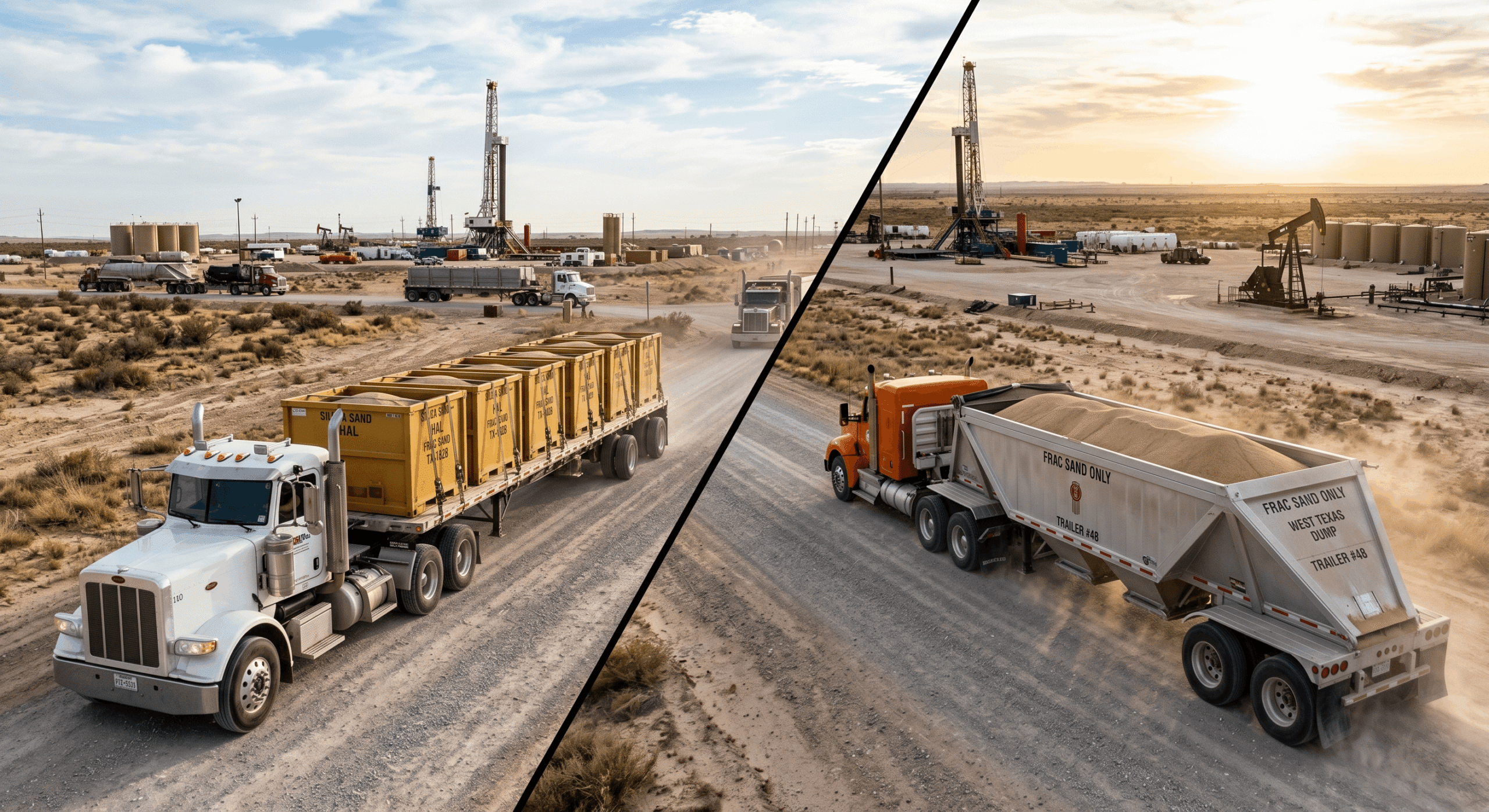
Here’s the workflow that defines this method’s economics: A driver picks up a loaded sand box from the transload or mine staging area on a flatbed trailer. The box is secured for transport (typically with twist-locks), and the driver hauls it to the wellsite. At the wellsite, a specialized telehandler or forklift — often called a “frac box handler” — lifts the loaded box off the flatbed and places it onto a fixed “drop frame” or stand. The box’s bottom gate opens onto an enclosed conveyor belt below the stand, which feeds the sand into the frac blender. The driver doesn’t wait through this entire process. Instead, the forklift swaps a previously-discharged empty box back onto the driver’s flatbed, and the driver leaves with the empty for the return trip. The complete wellsite cycle often takes 10–15 minutes.
That drop-and-go workflow is the sand box system’s defining advantage. Unlike belly dump operators who wait at the wellsite for the entire gravity discharge, sand box drivers complete the wellsite turnaround in roughly the same time it takes to swap one container for another. The actual sand discharge happens after the driver has left, feeding the conveyor on its own schedule. This enables higher loads per day and better driver utilization — the core economic argument for the sand box method.
One critical point most comparison articles miss: sand box hauling almost always requires leasing onto a sand box carrier. You generally can’t just buy a few boxes and start hauling independently — the boxes themselves are owned by the system company (Solaris, PropX, etc.) and the wellsite infrastructure (drop frames, conveyors, forklifts) is managed through the same operator. For an Owner-Operator, this means committing to a specific sand box carrier and running your flatbed within that contract structure. That’s a different business relationship than belly dump work, where you can lease your hopper trailer to many different carriers across the basin.
Why Major E&Ps Prefer Sand Boxes for Dust Control and Surge Capacity
Sand box systems have become the preferred sand delivery method for major Permian E&Ps — Pioneer Natural Resources, ExxonMobil Permian, and others — primarily for dust control. The fully sealed transfer pathway (sealed box during transport, sealed conveyor at the wellsite, enclosed transfer to the blender) dramatically reduces airborne silica dust compared to open-air dumping. With OSHA enforcement of silica regulations under 29 CFR 1926.1153 and 1910.1000 increasing, operators who can deliver sealed-system dust control are increasingly favored on regulated sites.
The same drop-frame infrastructure also enables surge capacity at the wellsite. Multiple loaded boxes can be staged simultaneously, allowing higher continuous pumping rates than belly dump dumping can sustain. For high-pumping-rate completions running 100+ stages back-to-back, this surge capability is operationally significant — and it’s part of why major E&Ps have invested in the wellsite infrastructure to support sand box delivery.
Driver Requirements & Skill Set for Sand Box Hauling
CDL-A is required, but the skill set is fundamentally simpler than other methods. Sand box drivers run flatbeds — a common trailer type that any experienced CDL-A holder is familiar with. There’s no blower system to learn, no hopper gate operation during dumping, no waiting through gravity discharge. The primary skills are flatbed handling, securing and unsecuring boxes for transport, and coordinating with the wellsite forklift operator during the swap.
That accessibility means sand box hauling can recruit drivers from a broader pool than specialized methods. Any flatbed-experienced CDL-A driver can transition into the role with minimal additional training. The trade-off is that sand box drivers are typically locked into specific carrier contracts — because the boxes and the wellsite infrastructure are tied to specific system companies — which limits market flexibility compared to belly dump work where your hopper trailer can lease to many different carriers.
Belly Dump Trailers: The Workhorse Alternative for Permian Sand Hauling
Belly dump trailers — also called hopper bottoms — are exactly what the name implies: high-capacity hopper trailers that discharge their load through bottom gates via gravity when the driver opens hydraulic controls. No sealed containers, no forklift swaps, no specialized infrastructure required at the wellsite. The driver backs into position over an open dump area or conveyor pit, opens the gates, and gravity does the work.
Offload time in optimal conditions runs 5–15 minutes for the actual gravity discharge — but the driver waits through the entire process and adds positioning time on either side. Total wellsite time often lands at 20–30 minutes per load. Legal payload typically runs 20–25 tons of commodity weight, slightly less than sand boxes in most configurations but not dramatically so.
Common configurations in the Permian are high-capacity hopper trailers in the 40–55 cubic yard range, built from steel or aluminum with multi-axle spread-axle designs to maximize legal weight. Manufacturers like Trail King, Timpte, and Wilson Trailer are prevalent across Permian fleets. These pull behind standard Class 8 tractors — no specialized chassis required. Sisu’s STX and WTX hopper bottom divisions operate hopper bottom equipment across South Texas and West Texas, with trailer lease options available depending on division and region.
The driver’s role during offload is more hands-on than sand box work — you’re operating the gates, managing load shifts during dumping, and navigating wellsite terrain to position the trailer correctly. It requires real skill, particularly in tight or uneven wellsite conditions, but the learning curve is accessible to experienced CDL-A holders without specialized oilfield backgrounds.
Wellsite Fit & Operational Flexibility for Belly Dumps
Belly dumps need space — ample, level ground for maneuvering and dumping. They’re not the right tool for tight automated batch plant setups or sites where dust containment is a hard requirement. But they integrate seamlessly with open sumps, conveyors, and temporary storage piles, which remain common across many Permian wellsites — particularly on bulk transfer runs from mine to transload, transload-to-storage operations, and smaller operator pads that haven’t invested in specialized sand box infrastructure.
The market flexibility is a significant advantage. A belly dump driver can lease onto multiple different carriers, run multiple lanes, and shift work as conditions change in the basin. Sand box drivers are tied to specific system contracts; belly dump drivers have the run of the basin. In a cyclical industry, that flexibility can be the difference between staying busy and getting parked when one customer slows down.
Belly Dump Maintenance & Reliability Profile
The mechanical simplicity of belly dump trailers is a genuine advantage. Common maintenance focuses on gate mechanisms, tarp systems, suspension, and brakes — none of which require specialized knowledge or exotic parts. Repairs are generally faster and cheaper than specialized hauling system work. Downtime events are less frequent and less severe, which translates directly to higher uptime and more consistent weekly income.
For an Owner-Operator running on tight margins, that simpler mechanical profile matters. Gate repairs typically run $500–$1,500, and you’re back on the road in a day or two. There’s no waiting for specialized parts to ship from a manufacturer’s facility, no need to find a shop with specific certifications. Standard CDL repair shops can handle nearly all hopper trailer issues.
Wondering whether frac sand hauling is worth the investment in 2026? The economics are real — but the details matter. Read the full breakdown of whether frac sand hauling is worth it in 2026 before you commit to either method.
Income Potential: Rates, Gross Revenue, and Real Take-Home Pay
Let’s get into the numbers that actually matter — and be honest about what they mean. Rate per ton is the headline figure, but it’s not the income figure. Your take-home pay is a function of rate, load count per day, total weekly volume, and operating costs. All four variables matter equally.
Sand box hauling in the Permian typically pays $10–$18 per ton to the carrier hauling the box. That rate is structurally lower than belly dump because the sand box system company (Solaris, PropX, etc.) takes a margin for box rental, infrastructure management, and the operating relationship with the E&P. The economic case for sand box hauling rests on volume — drop-and-go workflow allows 5–7 loads per day on typical Permian lanes, generating weekly gross of $2,000–$3,500+ for an active driver. Annualized, gross revenue potential lands in the $100,000–$170,000+ range depending on utilization and the specific carrier contract.
Belly dump trailers typically run $12–$20+ per ton in the Permian — slightly higher per-ton because the driver bears more of the operational workload (gate operation, wait time, hands-on dumping). Weekly gross for a belly dump Owner-Operator running consistent work lands in the $2,000–$3,500+ range at 4–6 loads per day, with annual gross revenue potential of $100,000–$170,000+.
Those ranges overlap by design. The honest answer is that a well-run sand box operation with high utilization and a fair carrier contract can produce comparable gross income to a well-run belly dump operation with strong rates and high volume. Sisu’s Owner-Operator-first model on the bottom drop side — including weekly direct deposit, no escrow, and minimal deductions — is built so Owner-Operators keep as much of their gross as possible.
The Volume vs. Rate Trade-Off in Permian Frac Sand Hauling
Here’s the math that most people skip. A sand box driver running 6 loads per day at $14/ton with 25 tons per box generates $2,100 in daily gross. A belly dump driver running 5 loads per day at $16/ton with 22 tons per load generates $1,760 in daily gross. The sand box driver wins on volume — but only if they actually complete 6 loads per day, which depends on box availability, forklift availability at the wellsite, and consistent dispatch.
Now flip the scenario: the sand box driver waits an hour for a forklift swap because the wellsite is busy and only completes 4 loads. The belly dump driver runs clean and completes 6 loads. The belly dump driver now generates $2,112 in daily gross vs. the sand box driver’s $1,400. Utilization is the hidden variable — and it’s the one you need to model honestly before you make a $50,000+ equipment decision.
Break-even analysis: a sand box driver needs higher daily load counts to match a belly dump driver’s weekly gross at typical Permian rate spreads. The crossover point depends entirely on your specific rates, load counts, and site conditions. Don’t let anyone tell you the math is simple — it isn’t.
TIP: Don’t Ignore the Utilization Factor
A $14/ton sand box rate sounds great until you realize you’re waiting an hour for a forklift swap during a busy completion. A $16/ton belly dump rate sounds modest until you realize you’re completing 6 loads per day on a clean lane. Model your income on realistic utilization — not best-case rates. Talk to drivers already running your target lanes and get their honest load count numbers before you commit to either method.
If you’re trying to model realistic income for your Permian hauling operation, that’s exactly what fleet partnerships are designed to help with. Sisu’s Owner-Operator-first model on the bottom drop side includes transparent rate structures and real utilization data so you can make informed decisions before you sign anything.
Operating Costs: Capital, Fuel, Maintenance, and Hidden Expenses
Gross revenue is the number that gets talked about. Net income is the number that matters. And net income is determined by how well you control your operating costs — which differ in interesting ways between sand box and belly dump operations.
Equipment capital is where the cost picture flips against the popular assumption. A standard flatbed trailer for sand box hauling runs $40,000–$70,000 — significantly less than a hopper bottom trailer at $70,000–$130,000+. The boxes themselves don’t enter the driver’s capital equation because they’re owned and maintained by the system company. So the entry capital for sand box hauling is actually lower than belly dump on the trailer side.
Fuel is similar between methods. Both pull behind a standard Class 8 tractor with no specialized power-takeoff or blower load — fuel consumption tracks roughly the same on equivalent lanes. With market diesel sitting around $5.50/gallon and active drivers running 15–22 loads per week, expect weekly fuel costs in the $1,800–$2,700 range after carrier fuel program discounts. Sisu’s negotiated fuel program delivers around 10–12% off market rates for drivers running on its authority — a meaningful buffer either way.
Maintenance favors belly dump simplicity. Hopper bottom maintenance focuses on gate mechanisms, tarp systems, suspension, and brakes — gate repairs typically run $500–$1,500 and turnaround is fast. Flatbed maintenance is even simpler in some respects (no gates, fewer moving parts), but flatbed-specific issues like deck damage, twist-lock mechanisms, and securement system wear can accumulate. Both methods are well within standard CDL shop capability — neither requires specialized facilities.
Insurance premiums are similar between methods. Belly dumps and flatbeds both carry standard commercial rates under FMCSA minimums of $750,000–$1,000,000 liability with cargo coverage of $100,000–$250,000. When leasing onto a carrier, insurance premiums are typically deducted from settlements — understanding exactly what you’re paying and what’s covered is essential before signing any lease agreement.
Total Cost of Ownership: 24-Month Scenario Comparison
Running the 24-month numbers gives you the clearest picture of true financial exposure. For sand box (flatbed) operations: lower trailer capital, similar fuel, simple maintenance, similar insurance. Total ownership costs over 24 months run approximately $40,000–$65,000+ on the trailer and operations side — not counting tractor costs, which are common to both methods.
For belly dump (hopper bottom) operations: higher trailer capital, similar fuel, simple maintenance, similar insurance. Total ownership costs over 24 months run approximately $60,000–$100,000+. The higher trailer cost is the primary driver of the gap. The trade-off: belly dump gives you market flexibility (you can lease your trailer to multiple carriers), while sand box ties you to specific system contracts.
Carrier Lock-In: The Hidden Cost of Sand Box Hauling
The carrier-lock cost isn’t a line item on a financial statement, but it’s real. Sand box drivers run on contracts tied to specific system companies and specific E&P customers. When that customer slows down, when the system company restructures, or when a contract isn’t renewed, you don’t have the option to easily move your trailer to another carrier — because the wellsite infrastructure (drop frames, conveyors, forklifts) you rely on belongs to the system company you’re already leased to.
Belly dump operators don’t have this constraint. Your hopper trailer can lease to any carrier with bottom drop authority, and your work doesn’t depend on a specific company’s infrastructure. That market flexibility has real economic value when basin conditions shift — and they do shift, often without much warning.
WARNING: Read the Sand Box Carrier Contract Carefully
Sand box hauling contracts often include exclusivity clauses, minimum-load commitments, and termination provisions that can cost you significantly if your work conditions change. Before signing, understand exactly what happens if the system company’s contract with the E&P ends, what your options are if loads slow down, and whether the carrier provides any minimum revenue guarantee. Belly dump work has fewer of these constraints — your trailer is portable across carriers, your skills are portable across operators, and your work isn’t tied to a single company’s customer relationships.
Regulatory, Safety, and Compliance Considerations for Permian Sand Haulers
Both methods operate under the same foundational regulatory framework — CDL-A required, FMCSA compliance mandatory, Texas overweight/oversize permitting essential — but there are meaningful differences in how each method interacts with safety regulations, particularly around silica dust exposure.
On the permitting side: max GVW is 80,000 lbs, but Permian haulers frequently run heavier loads requiring specific state and county permits. TxDOT permits cover state highways; county road permits are managed separately, and Permian Basin counties — Reeves, Ward, Loving — have specific road restrictions that vary by season and road condition. Spread-axle configurations are common in both methods to maximize legal weight distribution. Sand boxes don’t add specialized permitting beyond standard flatbed requirements.
Hazmat endorsements are not typically required for sand itself — it’s not a hazardous material. TWIC cards are relevant for port access but not standard for Permian intra-basin hauling. The regulatory complexity is primarily around weight, axle configuration, and road permits — not cargo classification. Sisu’s compliance and safety support includes FMCSA compliance management, ELD support through Motive, and guidance on permitting requirements — the kind of back-office infrastructure that lets Owner-Operators focus on driving instead of paperwork.
Silica Dust Exposure: A Critical Safety Difference Between Methods
OSHA’s silica dust regulations under 29 CFR 1926.1153 (construction) and 1910.1000 (general industry) apply to drivers who offload frac sand. The regulations require exposure assessment, implementation of engineering controls, respiratory protection when exposure exceeds action levels, and medical surveillance for workers with regular exposure. This isn’t optional, and enforcement is increasing.
The difference between methods is significant. Sand box systems deliver sand through a fully sealed pathway — the box stays sealed during transport, the conveyor system at the wellsite is enclosed, and the sand transfers into the blender without atmospheric release. Drivers’ direct exposure during the wellsite swap is minimal because they’re not handling open sand at any point. The dust control argument is part of why major E&Ps have standardized on sand box delivery for their regulated sites.
Belly dump offloading into open pits, conveyors, or temporary storage generates considerably more airborne silica dust. Drivers performing the dump process are in the exposure zone for the entire offload — typically 5–15 minutes of elevated dust generation. Proper PPE (N95 respirators at minimum, with P100 respirators preferred for regular exposure) is essential, and site-level engineering controls like water suppression systems should be in place. NIOSH studies confirm that open-air sand dumping creates meaningful silica exposure risk that requires active management. If long-term respiratory health is a priority for you — and it should be — sand box systems offer inherent protection that belly dumps require active mitigation to match.
Owner-Operator Legal Protections in Permian Hauling Contracts
FMCSA Part 376 governs Owner-Operator leases and provides meaningful protections against unfair contract terms, illegal deductions, and unclear compensation structures. Before you sign any lease agreement — whether for sand box or belly dump work — read the deductions schedule carefully. Understand what’s being deducted, when, and why. The Texas DTPA provides additional protection against deceptive trade practices. If something in a contract doesn’t make sense, ask for clarification in writing. Your financial future depends on understanding the terms you’re operating under.
Sand Box vs Belly Dump: Head-to-Head Comparison Matrix
Here’s the side-by-side breakdown across every major decision factor. Use this as your quick reference when modeling your own scenario.
| Factor | Sand Box (Flatbed Container) | Belly Dump (Hopper Bottom) |
|---|---|---|
| Wellsite Turnaround | 10–15 min (drop & go) ✓ | 20–30 min (wait through dump) |
| Payload Capacity | 22–30 tons ✓ | 20–25 tons |
| Trailer Capital | $40k–$70k (flatbed) ✓ | $70k–$130k+ (hopper) |
| Operating Costs | Comparable | Comparable |
| Per-Ton Rates | $10–$18/ton | $12–$20+/ton ✓ |
| Driver Skill Required | Standard CDL-A flatbed ✓ | CDL-A + hopper experience |
| Maintenance Complexity | Low (flatbed) ✓ | Low–Moderate (hopper) |
| Wellsite Fit | Drop frames + conveyors ✓ | Open dump areas, sumps ✓ |
| Dust Control | Superior (sealed system) ✓ | Requires PPE + controls |
| Market Flexibility | Locked to system contract | Multi-carrier portable ✓ |
EXPLAINER: What “Better” Really Means
There’s no universally “better” choice — only the better choice for your specific situation. Sand box wins on dust control, drop-and-go workflow, and lower trailer capital. Belly dump wins on per-ton rates, market flexibility, and faster repair turnaround. Your decision depends on your capital position, risk tolerance, target lanes, and whether you value drop-and-go workflow or market portability more. Anyone who tells you one method is always better than the other is selling something — or hasn’t done the math on both sides.
If your decision lands on belly dump, Sisu’s STX and WTX hopper bottom divisions cover the Permian and South Texas with transparent rates, weekly direct deposit, no escrow, and 24/7 live human dispatch. We don’t run sand boxes — that’s a different market — but if hopper bottom is your direction, we’re built for it.
Real-World Permian Scenarios: Which Hauling Method Wins in Each Situation?
Abstract comparisons only go so far. Let’s put both methods into specific Permian scenarios and see how the decision plays out in practice. These aren’t hypotheticals — they’re representative of actual work patterns in the Delaware and Midland basins right now.
Scenario 1 — High-Volume Major E&P Completion (Pioneer, ExxonMobil Permian):
Sand box wins. The operator has invested in drop frame infrastructure, requires sealed-system dust control, and runs at a pumping rate that benefits from box stockpiling. Work is consistent, drop-and-go workflow keeps drivers turning loads quickly, and the wellsite is designed around containerized delivery. This is the best-case scenario for sand box drivers — dedicated work with infrastructure built to maximize their productivity.
Scenario 2 — Mid-Tier Operator with Open-Site Infrastructure:
Belly dump wins. The operator has open dump areas and conveyors but no sand box infrastructure. Belly dump drivers have direct site access without specialized equipment dependencies. Higher per-ton rates and operational flexibility outweigh the wait-during-dump time penalty.
Scenario 3 — Mine-to-Transload Bulk Haul (Short Distance, High Volume):
Belly dump wins. Speed matters more than dust control on this run. You’re moving sand from a mine near Kermit or Orla to a transload facility — fast turnaround, multiple loads per day, no drop frame infrastructure required. Lower per-load operational complexity and faster turnaround at both ends make belly dump the clear choice.
Scenario 4 — Last-Mile Sand Box Contract (Established Drop Frame Network):
Sand box wins. The system company has established drop frame infrastructure across multiple wellsites, and the contract structure provides consistent volume. Drop-and-go workflow allows higher daily load counts than belly dump can match. This is the scenario where sand box’s drop-and-go advantage is fully realized.
Scenario 5 — Owner-Operator with Limited Capital Wanting Market Flexibility:
Belly dump wins. Higher trailer capital, but more market portability. Your hopper trailer can lease to multiple bottom drop carriers, run multiple lanes, and shift work as basin conditions change. If a contract slows down or a customer cuts back, you can move to another carrier without changing equipment. That flexibility has real value when basin conditions are uncertain.
Scenario 6 — Owner-Operator with Limited Capital Wanting Lower Entry Barrier:
Sand box wins on capital, with caveats. Flatbed trailers cost less than hopper bottoms, and you don’t have to capitalize boxes (the system company owns those). Lower entry capital is a real advantage. But you’re committing to a specific carrier contract — read the terms carefully and understand what happens if the contract structure changes. Lower capital with carrier lock-in is a different risk profile than higher capital with market flexibility.
Industry Trends: Where Is Permian Frac Sand Logistics Heading in 2026?
Equipment choices aren’t made in a vacuum — they’re made in the context of a market that’s moving in specific directions. Understanding where Permian frac sand logistics is heading helps you make a decision that positions you for sustained demand rather than a method that’s losing relevance.
The in-basin sand dominance trend is firmly established and continuing. With in-basin sand now fulfilling 50–70%+ of Permian demand, the long-haul component of frac sand logistics has contracted significantly. The action is in last-mile delivery — short, high-frequency runs from mine or transload to wellsite. This concentration of activity intensifies competition among carriers and puts a premium on efficiency, reliability, and wellsite integration.
Major E&P consolidation is reshaping the logistics landscape. As Pioneer, ExxonMobil Permian, and other large operators standardize their completion operations around automated wellsite infrastructure, demand for sand box delivery with drop frame integration has grown significantly on regulated sites. These operators increasingly favor dedicated last-mile providers with consistent performance over spot carriers with general-purpose trailers. Belly dump work remains strong on mid-tier operator sites and bulk transfer operations, but the major-E&P share of the market is increasingly sand box-dominated.
Silica dust regulations are tightening, and the trajectory is clear. OSHA enforcement of 29 CFR 1926.1153 and 1910.1000 is increasing, and E&P operators facing their own compliance obligations are increasingly specifying sealed-system delivery as a requirement on their regulated wellsites. This trend favors sand box systems on the regulated-site segment of the market while belly dump work remains strong on transfer operations and mid-tier sites where infrastructure investment hasn’t been made.
Driver availability is a meaningful factor in 2026. Belly dump capacity is generally available — the hopper bottom market has a deep driver pool and broad carrier availability. Sand box hauling has narrower carrier options but strong demand within those contracts. Both methods have steady work for qualified Owner-Operators willing to commit to consistent operations.
Technology integration is becoming a baseline expectation, not a differentiator. Fleets running Motive for ELD compliance, Ditat for dispatch optimization, and real-time visibility tools are attracting better shipper contracts and retaining drivers more effectively. Sisu’s tech-forward approach to fleet management — combining Motive, Ditat, and 24/7 live human dispatch — represents the direction the industry is moving. Owner-Operators who join fleets with this infrastructure are better positioned than those running with minimal tech support.
Making Your Decision: A Practical Framework for Permian Owner-Operators
You’ve got the data. Now let’s put it into a decision framework that respects your business judgment and helps you weigh your specific priorities against the numbers. Six steps — work through them honestly.
Step 1 — Assess your capital and risk profile honestly.
Do you have $40,000–$70,000 for a flatbed trailer and the willingness to lock into a sand box system contract, or is $70,000–$130,000 for a hopper trailer with broader market flexibility a better fit? Capital constraints AND market flexibility preferences both matter. Don’t choose lower capital if you can’t tolerate carrier lock-in; don’t choose higher capital if your cash position can’t support it.
Step 2 — Evaluate your target work specifically.
Are you chasing major E&P contracts with sand box infrastructure — sand box territory? Or bulk transfers, mid-tier operators, and open-site work — belly dump territory? Don’t choose equipment based on what you hope the market will give you. Choose based on the specific work you have access to right now, with realistic expectations about what you can add over time.
Step 3 — Model your utilization, not your best-case rate.
Build a weekly income model using realistic load counts — not the best day you’ve ever had, but the average day including wait times, mechanical delays, and dispatch gaps. Utilization drives income more than rate alone. A $14/ton sand box rate with 6 loads per day can match or exceed a $16/ton belly dump rate with 4 loads per day — but only if both numbers are realistic for your actual lanes.
Step 4 — Calculate your true operating costs using the 24-month TCO framework.
Factor in fuel, maintenance, insurance, and trailer costs — all of them, not just the easy-to-estimate ones. Use the cost ranges in this article as a starting point, then refine with quotes from your actual equipment and insurance providers. Compare apples to apples: total cost of ownership over 24 months, not just the monthly trailer payment.
Step 5 — Consider your market flexibility needs clearly.
Sand box hauling locks you into specific carrier contracts and the system company’s customer relationships. Belly dump hauling lets your trailer move between carriers as conditions change. If you value the freedom to shift carriers, take spot work, or run multiple lanes, belly dump’s portability is a real advantage. If you want predictable, dedicated work and don’t need that flexibility, sand box’s contract structure may suit you better.
Step 6 — Evaluate fleet support as a decision factor, not an afterthought.
The fleet you lease onto shapes your income as much as your equipment choice. Transparent pay structures, minimal deductions, 24/7 live human dispatch, compliance support, and equipment options are not perks — they’re the difference between keeping 70 cents of every dollar you earn and keeping 55 cents. Sisu’s Owner-Operator-first model on the bottom drop side — no escrow, weekly direct deposit, fuel cards with no fees, and low-cost insurance options — is built to maximize take-home pay for hopper bottom drivers running with the Pack.
VALIDATION: This Decision Matters — Take Your Time
You’re not just choosing equipment — you’re choosing your business model, income potential, and daily work experience for the next 2–3 years. Talk to drivers running both methods in the Permian. Model your own numbers with real data, not forum speculation. Don’t let rates alone drive the decision. The Pack respects your process here — take the time to get it right.
FAQ: Frac Sand Hauling in the Permian
These are the questions Owner-Operators ask most often when working through the sand box vs. belly dump decision. Straight answers, no hedging.
No — and the confusion is common but consequential. Sand boxes are sealed rectangular containers hauled on standard flatbed trailers. They’re discharged at the wellsite by a forklift swap onto a drop frame, with the sand feeding through an enclosed conveyor into the blender. Pneumatic tankers are completely different — pressurized vessels with truck-mounted blowers that blow sand directly into wellsite silos using compressed air. Different equipment, different workflow, different driver skill requirements. This article is comparing sand boxes vs. belly dump hopper bottoms — pneumatic tankers are a separate method altogether.
Neither method is universally better — the right choice depends entirely on your specific job requirements, target wellsites, and operational economics. Sand box systems are the preferred method on major E&P sites with drop frame infrastructure, where dust control is critical and drop-and-go workflow maximizes daily load counts. Belly dumps are stronger for bulk transfers, mid-tier operator sites without specialized infrastructure, and Owner-Operators who value market flexibility (your hopper trailer can lease to multiple carriers). Know your market before choosing your equipment.
Sand box hauling typically pays a lower per-ton rate ($10–$18/ton) but allows more loads per day through drop-and-go workflow. Belly dump pays a higher per-ton rate ($12–$20+/ton) but the driver waits through every offload, capping daily load counts. Net weekly gross is often comparable between the two methods at typical Permian utilization — the real differentiator is whether you can secure consistent high-volume work in either method. Model both scenarios with your actual numbers and target lanes before deciding.
Sand box hauling requires CDL-A and standard flatbed experience — securing and unsecuring boxes for transport, coordinating with the wellsite forklift operator during the swap, and standard flatbed handling. No specialized blower or hopper experience needed. Belly dump hauling requires CDL-A and hopper trailer experience — operating bottom gates, managing load shifts during dumping, and positioning on uneven wellsite terrain. Both are accessible to experienced CDL-A holders, with belly dump requiring slightly more hands-on hopper work and sand box being a more straightforward flatbed role.
Sand box systems offer substantially lower silica dust exposure risk because the entire transfer pathway is sealed — sealed box during transport, enclosed conveyor at the wellsite, sealed transfer to the blender. The driver’s direct exposure during the wellsite swap is minimal because they’re not handling open sand at any point. Belly dumps, which discharge sand into open pits, conveyors, or temporary storage, generate considerably more airborne dust during the offload process — requiring proper PPE (N95 minimum, P100 preferred for regular exposure) and site-level engineering controls. NIOSH studies confirm that open-air sand dumping creates meaningful silica exposure risk that requires active management.
Sand box hauling almost always means leasing onto a specific carrier tied to a specific system company (Solaris, PropX, etc.), because the boxes and wellsite infrastructure are owned and managed by that company. If the system company’s contract with the E&P slows or ends, your work options narrow significantly — you can’t easily move your flatbed to another carrier because the wellsite infrastructure you depend on belongs to the system company. Belly dump trailers can lease to any carrier with bottom drop authority across the basin. That market portability has real economic value when conditions shift — and conditions shift more often than you’d think. Read any sand box carrier contract carefully, understand the exclusivity and termination terms, and weigh the lock-in risk against the operational benefits.