
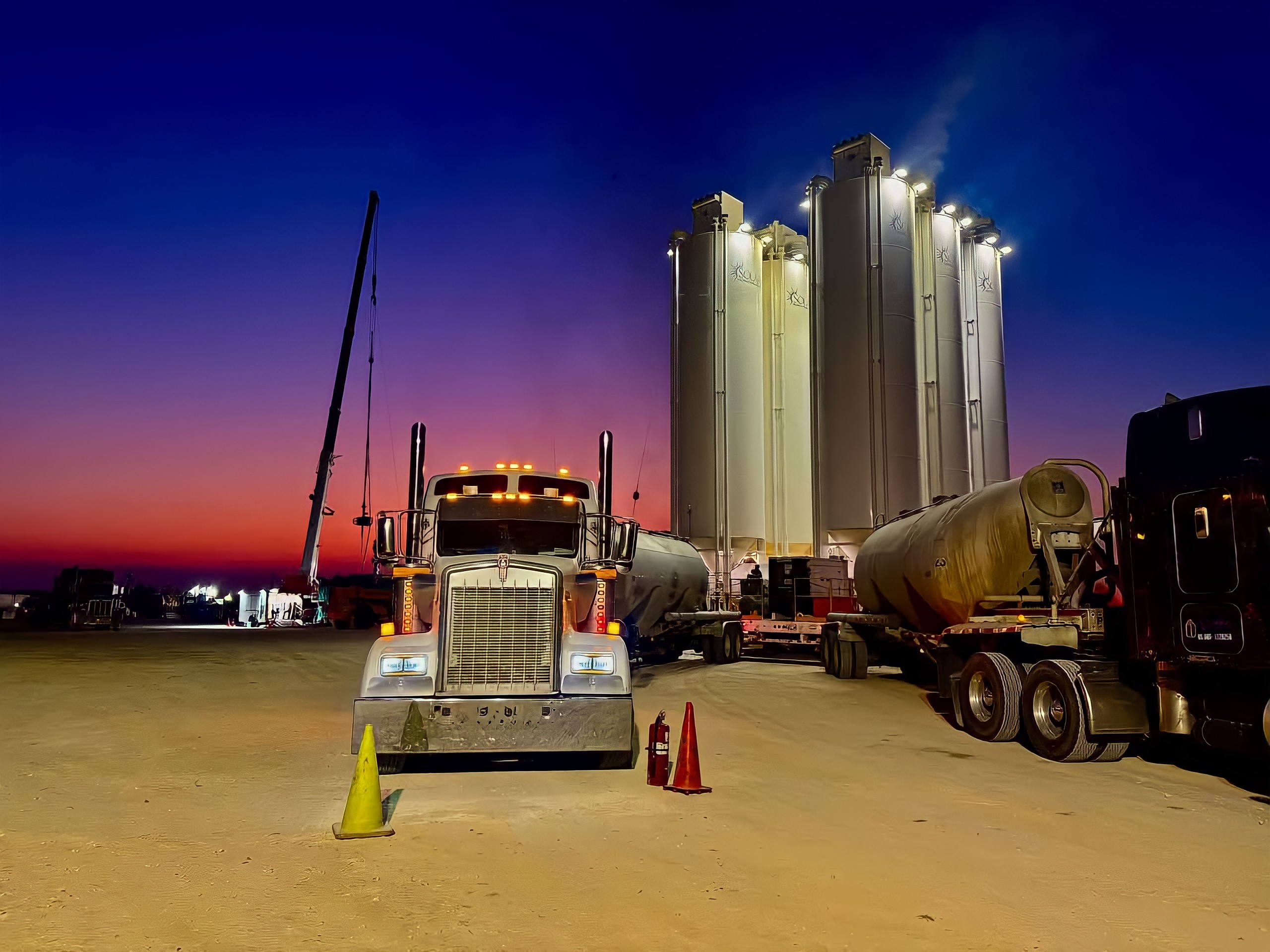
Is Frac Sand Hauling Worth It In 2026? Hear From An Industry Expert
Drivers see the ads. $5,000–$9,000+ gross per week hauling frac sand in the Permian Basin. That number is real — and it pulls people in fast. What the ads don’t show is what happens after fuel, insurance, truck payments, blower maintenance, and deadhead miles take their cut. When the dust settles, a productive Permian Basin owner-operator is realistically netting $1,000–$3,000+ per week — sometimes more if you’re running efficiently, sometimes less if you’re not. That gap between gross and net is where most drivers get surprised. And that surprise — that moment of “wait, this isn’t what I expected” — is exactly what this article is designed to prevent.
This isn’t a recruiting pitch. It’s a straight answer to the question every driver asks before making the jump into frac sand hauling: Is it actually worth it? We’re going to break down the real numbers, the market conditions heading into 2026, the hidden costs that catch new operators off guard, the regulatory requirements, and how to find the right carrier partner. By the end, you’ll have everything you need to make a confident, informed decision — no hype, no hedging.
Key Takeaways
- Permian Basin owner-operators can gross $5,000–$9,000+/week but net take-home after costs typically lands at $1,000–$3,000+
- 2026 frac sand demand in the Permian is projected to exceed 35 million tons, supporting sustained hauling activity
- Weekly operating costs range $3,220–$6,150+ — fuel, insurance, truck payment, maintenance, and blower upkeep
- Blower repair or replacement — a cost many new drivers overlook — can run $5,000–$15,000+
- Spot rates run $3.00–$6.00+/mile; contract rates offer more stability at $2.50–$4.50/mile
- Entry requires $50,000–$150,000+ in equipment and working capital — this is not a low-barrier business
- Carrier selection is one of the most important decisions you’ll make — dispatch model, pay transparency, and load consistency matter as much as per-mile rate
- The right carrier partner can be the difference between thriving and burning out in 18 months
The Frac Sand Hauling Opportunity in 2026: What’s Really Happening in the Permian and Eagle Ford
Before you can decide whether frac sand hauling is worth it, you need to understand the market you’re walking into. And in 2026, that market has some genuinely compelling fundamentals — alongside real risks that deserve honest discussion.
The Permian Basin remains the most active oil and gas play in North America. According to 2025 data from Baker Hughes, the Permian was running approximately 300–320 active rigs, with the Eagle Ford Shale holding steady at 70–80 rigs. These aren’t just drilling rigs — they represent completion crews, wellpad activity, and direct demand for frac sand logistics. Every active rig is a pipeline of work for pneumatic haulers.
Frac sand consumption in the Permian Basin alone was estimated at over 30 million tons in 2023, and projections from S&P Global Commodity Insights and Rystad Energy point to that figure exceeding 35 million tons in 2025–2026 as well intensity continues to climb. Operators are using 10–20+ million pounds of proppant per well — and in some high-intensity completions, that number pushes even higher. Every million pounds of sand is roughly 50 truckloads. The math on demand is not subtle.
The shift toward in-basin sand — West Texas and South Texas deposits rather than Northern White Sand shipped from Wisconsin — has been a sustained trend that directly benefits local logistics operators. Odessa, Midland, Laredo, and the surrounding hubs have become the nerve centers of frac sand logistics, with transload facilities and mine-to-wellpad routes creating a dense, active network of hauling opportunities. If you’re based in West Texas or South Texas, you’re sitting in the middle of one of the most active bulk hauling markets in the country.
Oil and gas price stability heading into 2026 supports operator completion budgets. The Dallas Fed Energy Survey has consistently shown that major E&P companies front-load spending in Q1 and Q2, creating seasonal demand spikes that translate to higher load availability and, in spot markets, elevated rates. Spring and fall typically see upticks in activity; summer heat and winter weather can create temporary slowdowns, but the Permian’s strategic importance to national energy production keeps the floor relatively high.
The bottom line on market conditions: the backdrop for frac sand hauling in 2026 is genuinely strong. Demand is real, sustained, and growing. If you’re considering joining our pack of owner-operators, you’re looking at a market that can support a profitable business — provided you go in with clear eyes about the costs and risks.
Real Numbers: Frac Sand Hauling Owner-Operator Gross Revenue vs. Net Take-Home
The Gross vs. Net Reality Check
You’ve probably seen ads promising $5,000–$9,000+ per week. That’s gross revenue — before fuel, insurance, truck payments, and blower maintenance. The gap between gross and net is where most drivers get surprised. This section breaks down the real numbers so you know exactly what to expect before you commit.
Let’s get specific. A productive owner-operator in the Permian Basin running 2,500–4,000 loaded miles per week at contract rates of $2.50–$4.50/mile or spot rates of $3.00–$6.00+/mile can realistically gross $5,000–$9,000+ per week. Eagle Ford operations tend to see slightly lower gross revenue — roughly $4,500–$8,000+ — due to shorter hauls and somewhat lower overall activity compared to the Permian. These are real numbers from real operators, not marketing projections.
Now let’s talk about what comes out of that gross. Here’s a realistic weekly operating cost breakdown for a Permian Basin owner-operator:
- Fuel: $1,500–$2,500 (the single largest variable cost, tied directly to diesel prices and miles)
- Insurance: $400–$800 (general liability, auto, and cargo combined)
- Truck payment or lease: $600–$1,200
- Maintenance reserves: $500–$1,000 (preventive maintenance, tires, unexpected repairs)
- Blower maintenance: $100–$300 (routine upkeep — can spike dramatically if repairs are needed)
- ELD compliance: $20–$50
- Miscellaneous (permits, fees, etc.): $100–$300
- Total estimated weekly costs: $3,220–$6,150+
Run the math: at the high end of gross ($9,000) and the low end of costs ($3,220), you’re netting roughly $5,780. At the low end of gross ($5,000) and the high end of costs ($6,150), you’re in negative territory. The realistic middle ground — for a driver running efficiently with consistent loads — is $1,000–$3,000+ per week in net take-home. That’s a meaningful income, but it’s a far cry from the gross figures that get advertised.
Deadhead miles are one of the biggest levers on that net figure. Typical deadhead in frac sand hauling runs 15–25% of total miles. Every empty mile you drive reduces your average revenue per mile across the entire week’s run. Sisu’s all-pneumatic divisions are built around optimizing loaded miles — because we know that even a 5% improvement in deadhead management can add $500+ to your weekly net.
Pro Tip: Deadhead Miles Kill Profitability
Every empty mile you drive reduces your average revenue per mile. Experienced owner-operators obsess over managing deadhead — securing return loads, optimizing routes, and negotiating backhaul rates. Even a 5% improvement in deadhead can add $500+ to your weekly net. Ask any carrier you’re evaluating how they manage deadhead for their drivers. If they don’t have a clear answer, that’s a red flag.
The Hidden Costs Nobody Talks About in Frac Sand Hauling
The weekly cost breakdown above covers the predictable expenses. What it doesn’t cover are the costs that catch new operators completely off guard — the ones that can turn a profitable month into a break-even or worse.
The Blower System Surprise
Blower repair or replacement is the hidden cost that catches most new pneumatic drivers off guard. A major blower failure can cost $5,000–$15,000+ and sideline your truck for weeks. Budget for this upfront and maintain your blower religiously — it’s your most expensive component and your most critical piece of equipment. If your blower goes down, you don’t haul. If you don’t haul, you don’t earn.
Beyond the blower, here’s what else needs to be in your financial model:
- Specialized pneumatic equipment insurance riders: Add $100–$300+ annually on top of base coverage
- Mandatory safety certifications: PEC SafeLand, DISA, HAAS, and operator-specific training run $100–$300+ per certification, plus training time — and you’ll need to renew them
- Detention time losses: If you’re stuck at load or unload sites without detention pay, you can lose $500–$1,000+ per week in unpaid time
- Equipment depreciation: Over a 3-year horizon, ATRI data and industry estimates suggest $50,000–$100,000+ in depreciation depending on truck and trailer age, mileage, and condition
- Downtime during repairs: Every day your truck is in the shop is a day you’re not earning — and you’re still paying insurance, truck payments, and other fixed costs
The 3-year financial picture requires honest planning. An owner-operator entering the frac sand market in 2026 should have a realistic reserve fund — ideally 3–6 months of operating costs — to weather equipment failures, market slowdowns, and the inevitable unexpected expenses. This isn’t pessimism; it’s the difference between building a sustainable business and burning out in 18 months.
Spot Rates vs. Contract Rates: Which Frac Sand Hauling Model Pays Better?
Spot Rates vs. Contract Rates: The Trade-Off
Spot rates ($3–$6+ per mile) offer upside during booms but are unpredictable. Contract rates ($2.50–$4.50 per mile) are stable but may leave money on the table during peaks. The right choice depends on your risk tolerance, financial reserves, and need for predictability. Many successful owner-operators use a mix of both — and the best carrier partners give you that flexibility.
This is one of the most practical decisions you’ll make as a frac sand hauling owner-operator, and it’s worth spending real time on it rather than defaulting to whichever option sounds better in the moment.
Spot rates in pneumatic frac sand hauling currently run $3.00–$6.00+ per mile, with the upper end of that range appearing during peak demand periods — particularly Q1/Q2 when operators are front-loading completion schedules. Spot rates compensate for unpredictability: you’re taking on the risk of load gaps, payment uncertainty with unknown counterparties, and rate volatility in exchange for the potential to capture premium rates during high-demand windows. When the market is hot, spot haulers can significantly outperform contract drivers. When the market softens, they feel it first and hardest.
Contract rates typically run $2.50–$4.50 per mile — lower ceiling, but far more predictable. Contract work offers consistent miles, reliable payment cycles, and the ability to actually plan your life and your finances. For drivers with family obligations, mortgage payments, or equipment financing, that predictability has real dollar value that doesn’t show up in a simple per-mile comparison. The spread between spot and contract can be $1.00–$2.00+ per mile — but that spread disappears during market slowdowns when spot rates drop toward contract levels anyway.
The honest answer is that most experienced owner-operators run a blend — contract work as the foundation for consistent miles and cash flow, with spot opportunities layered on top when conditions are favorable. A carrier partner with 24/7 live human dispatch can help you navigate that mix in real time, identifying opportunities and protecting you from taking loads that don’t pencil out.
One critical note on spot work: payment verification is non-negotiable. Spot markets carry non-payment risk that contract arrangements don’t. Always verify a broker or shipper’s payment history before hauling — tools like DAT’s credit scores and carrier reviews exist for a reason. A load that pays $5.50/mile means nothing if you spend three months chasing the check.
If you’re weighing rate stability against upside potential, that’s exactly what a carrier partner should help you navigate. Sisu’s mix of contract and spot opportunities lets you choose the model that fits your risk tolerance — and our live dispatch team is in your corner every step of the way.
Market Demand Drivers: Why 2026 Frac Sand Hauling Could Be Strong — or Weak
Understanding the macro factors that drive frac sand hauling demand isn’t just academic — it’s essential for making a smart business decision. The market you enter in 2026 will be shaped by forces largely outside your control. Knowing what they are lets you position yourself to benefit from the upside and protect yourself against the downside.
Oil and gas prices are the single most powerful variable. When prices are sustained at levels that support robust drilling and completion budgets — generally $70+/barrel for West Texas Intermediate — operators run full completion schedules and demand for frac sand logistics stays high. A sharp price correction changes the math fast: operators defer completions, completion crews get laid off, and load availability drops. The 2015–2016 and 2020 downturns are instructive — drivers who had financial reserves and carrier relationships survived; those who didn’t often had to exit the market entirely.
Well complexity and sand intensity continue to trend upward. Operators are drilling longer laterals and using more proppant per lateral foot — some wells now consuming 10–20+ million pounds of sand per completion. This trend directly translates to more truckloads per well and more demand for pneumatic haulers. Even if the total number of wells completed stays flat, increasing sand intensity means more hauling work per completion.
In-basin sand preference continues to favor West Texas and South Texas logistics operators. Permian sand costs significantly less to transport than Northern White Sand from Wisconsin, and the quality gap has narrowed enough that most operators now default to in-basin supply. This structural shift has been a sustained tailwind for Odessa, Midland, and Laredo-based haulers — and it’s not going away.
Seasonal patterns matter for cash flow planning. Spring and fall typically see upticks in load availability as operators push to hit completion targets. Summer heat in West Texas can slow operations — both for safety reasons and because extreme heat affects equipment performance. Winter weather, while less severe in South Texas than in northern basins, can create temporary slowdowns. Budget for these patterns rather than assuming a flat weekly income throughout the year.
The Owner-Operator Market in 2026: Consolidation, Competition, and Real Opportunity
The frac sand hauling market isn’t a monolith. It’s a diverse ecosystem of large national fleets, mid-size regional carriers, and independent owner-operators — all competing for loads in the same basins. Understanding where you fit in that landscape is critical to building a sustainable business.
Carrier consolidation has been a real force over the past 2–3 years. Some smaller players have been acquired or forced out by profitability pressures, tighter insurance requirements, and the capital demands of maintaining a compliant fleet. This consolidation has actually created opportunity for owner-operators who can demonstrate reliability and professionalism — shippers and operators increasingly prefer working with established carriers and experienced independent drivers over unknown quantities from load boards.
The driver shortage in oilfield hauling is a persistent structural reality. The American Trucking Associations and OOIDA data consistently show that experienced pneumatic tanker drivers — particularly those with oilfield certifications and a track record in demanding environments — are in high demand. This shortage gives qualified owner-operators genuine negotiating leverage, both on rates and on carrier selection. You don’t have to take the first deal offered to you.
Owner-operator models vary significantly in how they structure the relationship between driver and carrier. The main options are: lease-on with a carrier (most common, offers load consistency and dispatch support), broker arrangements (flexible but rate-volatile), direct operator contracts (most lucrative but requires established reputation), and load board access (maximum flexibility, minimum support). Each has trade-offs that we’ll explore in more detail in the section on finding work.
New entrants do face higher barriers than they did five years ago. Equipment costs have risen, insurance requirements have tightened, and shippers increasingly demand certified, experienced drivers. This isn’t a market you can enter with a used truck, a CDL, and no oilfield background and expect to thrive immediately. But for drivers who come in prepared — with the right equipment, certifications, and a solid carrier partner — the 100% owner-operator fleet model offers genuine upside that company-driver positions simply can’t match.
Regulatory Requirements and Compliance: What Every Frac Sand Hauling Driver Must Know
Compliance isn’t optional in this business — and the cost of getting it wrong goes well beyond fines. A single compliance failure can get you pulled off a wellpad, suspended from a shipper’s approved carrier list, or shut down entirely. Here’s what you need to know before your first load.
CDL requirements: You need a Class A CDL with a Tanker (N) endorsement. This is non-negotiable for pneumatic frac sand hauling in Texas. Some operators may also require Hazmat (H) endorsement depending on site-specific classifications, though frac sand itself isn’t classified as hazardous material under standard FMCSA definitions.
FMCSA operating authority: Owner-operators need both a USDOT number and an MC (Motor Carrier) number. Your authority must be active and in good standing — verify at safer.fmcsa.dot.gov before operating commercially. Biennial updates are mandatory; letting your authority lapse is a business-ending mistake.
Insurance minimums: FMCSA requires minimum liability of $750,000. But here’s the reality: oilfield operators and E&P companies routinely require $1,000,000 or more in liability coverage before you can access their wellpads. Budget for the higher limit — it’s not optional if you want to work in this market. Cargo coverage and pneumatic equipment riders add to the base cost.
Site-specific safety certifications: PEC SafeLand, DISA, HAAS, and operator-specific training are required for wellpad access. These aren’t one-time costs — they require periodic renewal, and different operators may require different certifications. Budget $100–$300+ per certification, plus the time cost of completing the training. Some carriers coordinate this for their drivers; others leave it entirely to the individual.
Hours-of-service rules: Standard FMCSA HOS rules apply. The agricultural exemption is generally not available for frac sand hauling. The oilfield exemption (for operations within a 150 air-mile radius) may apply in some situations, but the rules are complex and you should consult with a compliance professional before relying on this exemption. ELD mandate compliance is required — no exceptions.
2026 regulatory landscape: Potential updates to FMCSA safety regulations, stricter emissions standards for commercial vehicles, and Texas DOT permitting changes for overweight loads are all on the horizon. Energy companies are also continuously enhancing site safety mandates, which can create new training requirements. Staying current on regulatory changes isn’t optional — it’s part of running a compliant business.
Insurance and Bonding: The Real Cost of Coverage
Insurance is one of the most significant fixed costs you’ll carry as an owner-operator, and it’s also one of the most important protections you have. Don’t cheap out here. General liability, auto, and cargo coverage combined typically runs $400–$800 per week for a well-insured pneumatic operator. Pneumatic equipment riders add $100–$300+ annually on top of the base policy.
When evaluating carriers, pay close attention to their group insurance programs. A carrier with a strong group insurance option can significantly reduce your individual insurance costs — this is a real, tangible financial benefit that doesn’t always get the attention it deserves when drivers are comparing per-mile rates.
On bonding and escrow: some carriers require escrow deposits as a condition of leasing on. A small, clearly refundable deposit is standard practice. Large escrow requirements, non-refundable escrow, or vague terms around escrow release are red flags that we’ll cover in detail in the predatory practices section.
Compliance and certifications can feel overwhelming, but the right carrier makes it manageable. Sisu handles PEC, HAAS, and site-specific training coordination so you can focus on what you do best — driving.
How to Find Frac Sand Hauling Work: Carriers, Brokers, and Direct Relationships
Finding consistent, well-paying loads is the operational challenge that separates thriving owner-operators from struggling ones. The market has multiple pathways to work — each with different trade-offs on rate, consistency, and support.
Lease-on with a carrier is the most common path for owner-operators entering the frac sand market. You bring your truck and equipment; the carrier provides dispatch, load access, compliance support, and often group insurance. Per-mile rates may be slightly lower than what you’d negotiate independently, but the consistency and support infrastructure have real value — especially when you’re getting started. Sisu’s streamlined onboarding process is designed to get qualified drivers running quickly, with minimal friction and maximum transparency about what you’ll earn and what will be deducted.
Load boards like DAT and Truckstop offer flexibility and access to a wide range of spot loads. The trade-off is that rates on load boards are often lower than what you’d get through a carrier relationship, payment verification is your responsibility, and you’re operating without dispatch support. Load boards work well as a supplement to a carrier relationship — less well as your primary source of loads, particularly when you’re new to the market and haven’t built a reputation yet.
Freight brokers with oilfield specialization can be valuable partners — they have relationships with shippers and can provide access to loads you wouldn’t find independently. The key word is “specialization.” A general freight broker dabbling in oilfield loads is not the same as a broker who lives in this market and knows the operators, the routes, and the payment cycles. Vet your brokers carefully.
Direct relationships with sand mines and transload operators represent the highest-value pathway for experienced, established operators. These relationships develop over time — they’re built on a track record of reliability, professional conduct, and consistent performance. New entrants can’t walk in and demand direct contracts; they’re earned. But building toward direct relationships should be part of your long-term strategy, because the rates and consistency available through direct operator relationships are the best in the market.
Red Flags: Predatory Carrier Practices and How to Protect Yourself
Red Flags That Signal a Bad Carrier
If a carrier requires escrow beyond a small refundable deposit, forces you to take unprofitable loads, withholds pay beyond 30 days, or hides deductions, walk away. These are signs of a carrier that prioritizes its own cash flow over driver success. Your carrier should be transparent and aligned with your profitability — not working against it.
The frac sand hauling market has its share of predatory operators. Knowing the red flags before you sign anything is the difference between a good business decision and a costly mistake. Here’s what to watch for:
- Escrow requirements beyond a small refundable deposit: This is a major red flag for financial control issues. A legitimate carrier doesn’t need to hold large amounts of your money as leverage.
- Forced dispatch: Requiring you to take loads you’ve identified as unprofitable or unsafe is a sign of a carrier that prioritizes volume over driver success. You’re a business owner — you have the right to evaluate loads.
- Hidden deductions: Any fees not clearly disclosed upfront in writing are a problem. Demand itemized statements before you sign and verify that what you see on paper matches what hits your account.
- Pay cycles exceeding 30 days: Weekly direct deposit is the standard in this market. Carriers who pay every two weeks, or monthly, or “when the shipper pays us” are creating cash flow problems for you while solving their own.
- Overly restrictive equipment mandates: Requiring specific expensive trucks or trailers without reasonable lease terms or compensation is a way of trapping drivers in equipment arrangements that benefit the carrier.
- Broad non-compete clauses: These limit your ability to pivot if the relationship sours. Read every contract carefully and understand what you’re agreeing to before you sign.
- Pressure to falsify logs or safety records: This is illegal, dangerous, and career-ending. Walk away immediately — no load is worth your CDL, your safety, or your freedom.
If you encounter any of these practices, OOIDA resources for owner-operator protection are invaluable. OOIDA has legal resources, dispute resolution support, and a community of experienced drivers who’ve seen every trick in the book. Membership is worth it for the protection alone.
Equipment Choices for Frac Sand Hauling: Pneumatic vs. Hopper Bottom, Lease vs. Own
Your equipment choices have a direct, lasting impact on your profitability, your flexibility, and your stress level. Get this decision right upfront — changing course after you’ve committed to a truck and trailer is expensive.
Pneumatic trailers are the standard for frac sand hauling. The blower system allows sand to be discharged via air pressure directly into the sand storage systems at wellpads — it’s the required method for most oilfield sand delivery. Pneumatic hauling commands premium rates precisely because of the specialized equipment and skill required. The trade-off is higher operating costs: blower maintenance, specialized insurance riders, and the risk of a major blower failure. But the premium rates justify those costs when you’re running consistently.
Hopper bottom trailers offer a lower-cost entry point. They don’t require a blower system, they’re less expensive to maintain, and they can serve multiple markets beyond frac sand — grain, aggregate, and other dry bulk commodities. Rates are lower than pneumatic, but so are operating costs. For drivers without oilfield experience who want to enter the frac sand market, hopper bottom can be a smart starting point that builds the regional knowledge and shipper relationships needed to eventually move into pneumatic work.
On the lease vs. own question: leasing reduces upfront capital requirements but increases weekly costs by $200–$350+ per week depending on the trailer and lease terms. Owning builds equity and reduces weekly costs over time, but requires significant capital upfront and puts all maintenance risk on you. For drivers who are new to the market or uncertain about long-term commitment, leasing is the lower-risk path. For experienced operators with capital reserves and a clear long-term plan, ownership makes more financial sense over a 3–5 year horizon.
Your truck needs to be up to the demands of loaded frac sand hauling. You’re looking at 400–550 HP, 10-speed transmission, and a strong Jake brake as baseline requirements. Loaded sand hauls are heavy, the roads to wellpads are rough, and the terrain in West Texas and South Texas demands a truck that can handle sustained hard work. Don’t try to save money by running an underpowered or high-mileage truck in this application — the maintenance costs and downtime will eat you alive.
Total entry cost — truck, trailer, working capital, certifications, and insurance — runs $50,000–$150,000+ depending on whether you’re leasing or buying, new or used. This is not a low-barrier business. But Sisu’s equipment lease programs are designed to reduce that barrier for qualified drivers who have the experience but not the full capital to enter the market independently.
Is Frac Sand Hauling Worth It in 2026? The Honest Verdict
You came here for a straight answer. Here it is.
For the right driver, in the right market, with the right carrier partner — yes, frac sand hauling is worth it in 2026. The demand fundamentals are strong. The driver shortage creates genuine leverage for qualified operators. The premium rates available in pneumatic hauling, combined with the Permian Basin’s sustained activity, create real income potential that most trucking segments can’t match.
But “the right driver” matters enormously here. The best-fit profile for a successful frac sand hauling owner-operator in 2026 looks like this:
- Experienced driver with Class A CDL and ideally some oilfield or pneumatic background
- Capital reserves of 3–6 months of operating costs beyond equipment purchase
- Strong financial discipline — the ability to manage cash flow during market slowdowns
- Willingness to invest in certifications, maintenance, and equipment quality
- Negotiation skills and the confidence to evaluate loads critically
- A carrier partner who is genuinely aligned with driver success, not just their own volume
The downside risks are real and shouldn’t be minimized. This is a cyclical market. Oil price volatility is the wild card that can turn a strong market into a difficult one with relatively little warning. Equipment depreciation, blower failures, and the physical demands of oilfield hauling create ongoing costs and stress that don’t show up in the gross revenue numbers. Income volatility is a feature of this business, not a bug — you need to be built for it financially and mentally.
“The question isn’t whether the money is there — it is. The question is whether you have the discipline, the reserves, and the right partner to capture it consistently over time. That’s what separates the operators who build real businesses from the ones who burn out in 18 months.”
Timing matters too. 2026 projections suggest strong demand, but the oil and gas market can shift. Entering during a strong market with a solid financial foundation is very different from entering during a peak with no reserves and hoping the good times last. Go in prepared, not optimistic.
Choosing the Right Frac Sand Hauling Carrier Partner: What to Look For
Your carrier partner is one of the most consequential decisions you’ll make as an owner-operator. The wrong carrier can cost you thousands of dollars per month in hidden fees, poor load management, and wasted miles. The right carrier amplifies your earnings, protects your time, and treats your business like a partner — not a resource to be extracted from.
Here’s the checklist that matters:
- Dispatch model: 24/7 live human dispatch is not a luxury in oilfield logistics — it’s a necessity. Complex, time-sensitive loads in remote locations require real human judgment and responsiveness. App-only dispatch systems can’t handle the nuance of oilfield hauling. Ask specifically: who answers the phone at 2 AM on a Sunday when you have a problem?
- Load consistency: Ask for average weekly miles and load availability data, not peak numbers. Consistency is worth more than peak rates. A carrier who can guarantee 2,500+ loaded miles per week at $3.50/mile beats one who promises $5.00/mile but can only fill your truck 3 days a week.
- Pay transparency: Itemized settlement statements, no hidden deductions, weekly direct deposit, and a clear fee structure communicated upfront. If a carrier can’t show you exactly what will be deducted from your settlement before you sign, walk away.
- Insurance program: Quality, affordable group insurance options are a major financial benefit. Compare the total cost of insurance through the carrier versus sourcing it independently. The difference can be $100–$300+ per week.
- Technology: Modern ELD platform, load board access, and dispatch integration reduce friction and maximize loaded miles. The best carriers use technology to serve drivers — not to monitor them like employees.
- Driver support: Safety programs, training coordination, equipment maintenance support, and responsive customer service. When something goes wrong — and it will — you want a carrier who picks up the phone and helps solve the problem.
- Reputation: Check OOIDA forums, TruckersReport, and Reddit (r/Truckers, r/OwnerOperators) for real driver feedback. Consistent complaints about pay, dispatch, or deductions are not isolated incidents — they’re patterns. Consistent praise is meaningful signal.
Sisu’s driver-first approach is built around exactly these criteria. 100% owner-operator fleet — no company trucks competing for your loads. Weekly direct deposit with transparent, itemized settlements. 24/7 live human dispatch. Group insurance options. And a culture that treats drivers as the most important asset in the business — because they are. That’s not a marketing line; it’s the operating principle the entire company is built on.
Ready to evaluate your options? Sisu’s 100% owner-operator fleet, 24/7 live dispatch, and transparent pay structure are built on one principle: your success is our success. See if Sisu’s model fits your goals.
Frequently Asked Questions About Frac Sand Hauling in 2026
How much money can I really make as a frac sand hauling owner-operator?
A productive owner-operator in the Permian Basin can realistically gross $5,000–$9,000+ per week, but net take-home after operating costs typically ranges from $1,000–$3,000+ weekly. Success depends heavily on miles driven, cost management, and securing consistent loads — the difference between a driver netting $1,200/week and one netting $3,000/week often comes down to deadhead management, carrier quality, and equipment reliability. Eagle Ford operations may see slightly lower gross revenue due to shorter hauls and somewhat lower activity compared to the Permian Basin.
What kind of truck and trailer do I need for frac sand hauling?
You’ll need a Class A CDL with a Tanker (N) endorsement and a powerful semi-truck — typically 400–550 HP with a 10-speed transmission and a strong Jake brake capable of handling heavy loads and rough oilfield terrain. For frac sand specifically, a pneumatic (air) tanker trailer with a blower system is essential — it allows sand to be discharged via air pressure directly into wellpad storage systems. Total equipment costs range from $50,000–$150,000+ depending on whether you lease or own, and whether you’re buying new or used. The blower system is your most critical and most expensive component — budget for its maintenance and potential replacement from day one.
Is frac sand hauling a stable job or is it feast or famine?
Frac sand hauling is genuinely cyclical — it’s heavily influenced by oil and gas prices and exploration activity, and strong demand periods can be followed by sharp slowdowns when prices correct. The 2015–2016 and 2020 downturns demonstrated how quickly the market can contract. That said, the Permian Basin’s structural importance to U.S. energy production creates a higher floor than many other oilfield markets. Success in this business requires financial reserves to weather slowdowns and a carrier partner who prioritizes load consistency over volume — not just chasing the highest spot rate when times are good.
What are the biggest hidden costs for an owner-operator in this business?
Beyond fuel and standard maintenance, budget carefully for blower system repairs or full replacement — a major blower failure can run $5,000–$15,000+ and sideline your truck for weeks. Specialized insurance riders for pneumatic equipment, mandatory safety certifications (PEC, SafeLand, HAAS — each $100–$300+ and requiring periodic renewal), and detention time losses if not actively managed can quietly drain profitability. Over a 3-year horizon, equipment depreciation can exceed $50,000–$100,000+ depending on truck and trailer age and mileage — a cost that needs to be factored into your long-term financial model, not ignored.
How do I find loads if I’m an owner-operator?
Owner-operators typically find work through one of four pathways: leasing onto a carrier (most common, best for consistency and support), working with oilfield-specialized freight brokers (access to varied loads but rate volatility), using load boards like DAT and Truckstop (maximum flexibility, often lower rates), or developing direct relationships with sand mines and transload operators (highest value but requires established reputation). Most successful operators start with a carrier lease-on to build regional knowledge and shipper relationships, then layer in direct and broker opportunities as their reputation grows. The carrier you choose as your starting point matters enormously — choose one with strong load consistency and transparent pay.
What should I look for when choosing a carrier to work with?
Prioritize 24/7 live human dispatch (not app-only), load consistency with verifiable average weekly miles, transparent pay with itemized settlements and no hidden deductions, quality group insurance options, modern ELD and dispatch technology, and strong driver support including safety programs and responsive service. Before signing anything, check OOIDA forums, TruckersReport, and Reddit for real driver feedback — consistent complaints about pay, deductions, or dispatch are patterns, not exceptions. Avoid carriers with large escrow requirements, forced dispatch, or pay cycles exceeding 30 days. Weekly direct deposit is the standard; anything less is a red flag.
Karrie Grundy
This is the truest thing I’ve seen written about this industry in a while. So informative, and imperative for owner operators to understand right now. Bravo, Logan! Well done.